On this page
- Quick facts
- How the speaking test works
- How the speaking score works
- The four criteria, turned into drills
- IELTS speaking tips
- Part 1: common topics and 12 model answers
- Part 2: the cue card method
- Part 3: answering abstract questions
- Common mistakes by first language
- A 4 week speaking plan
- Practice Parts 1 to 3 with a bestie by chat and by call
- How to improve IELTS speaking
- Free official practice
- Test day checklist
- FAQ
- About this page
- Sources
Good IELTS speaking practice is short, regular and out loud. The test lasts 11 to 14 minutes, the format never changes, and the marking rests on four criteria that you can train one at a time. This page gives you the format, a band by band table of what each criterion sounds like, twelve Part 1 answers from different speakers, 25 Part 2 topics, a Part 3 question bank, one Part 2 topic answered with three different sets of features, and a four week routine with a test day checklist.
Practice Parts 1 to 3 out loud with your bestie. LingoBestie is an iOS app with IELTS speaking sets, model answers and an estimated band on your answers, plus chat, voice calls and video calls with a friend who remembers your week. Start with 7 days free on the yearly plan. See LingoBestie
Quick facts
| Length | 11 to 14 minutes, in three parts |
| Format | One examiner, face to face with you. At some centres the examiner joins by live video call. The test is recorded |
| Parts | 1: interview (4 to 5 min). 2: long turn (3 to 4 min including 1 min preparation). 3: discussion (4 to 5 min) |
| Marked on | Fluency and coherence, lexical resource, grammatical range and accuracy, pronunciation |
| Same for | Academic and General Training |
| Source | The official IELTS format page and band descriptors (Sources 1, 2 and 4), last checked November 2026 |
How the speaking test works
You arrive, show your ID and meet one examiner. The conversation is recorded, and the examiner marks you as you speak. The test is a face to face interview. Some centres use a video call, where the examiner is a real person on a screen and the content, timing and scoring are the same (Source 3).
Here is the shape of the 11 to 14 minutes.
| Part 1: interview | Part 2: long turn | Part 3: discussion |
|---|---|---|
| 4 to 5 minutes | 3 to 4 minutes, with 1 minute to prepare and up to 2 minutes to speak | 4 to 5 minutes |
| Home, work or study, everyday topics | One task card, then one or two short follow up questions | Wider, more abstract questions linked to the Part 2 topic |
Part 1, the interview. The examiner introduces themselves, confirms who you are, then asks questions about familiar things: home, work or study, and two or three everyday topics. This part is about sounding natural, and it is marked like the rest.
Part 2, the long turn. You receive a task card with a topic and prompts, a pencil and paper, and one minute to prepare. Then you speak for up to two minutes. The examiner may ask one or two questions on the same topic afterwards (Source 1).
Part 3, the discussion. The examiner moves from your personal story to the wider topic: society, trends, comparisons, predictions. The language demand goes up, because you must explain, compare and speculate rather than tell a story.
How the speaking score works
The four criteria carry equal weight, and their average gives your Speaking score. Your Overall band is the average of Listening, Reading, Writing and Speaking, rounded to the nearest half band, so Speaking counts for a quarter of it (Source 5). For example, an average of 6.25 rounds up to 6.5 and an average of 6.75 rounds up to 7.0.
Official band scores come from IELTS examiners marking the real test. Everything on this page is built to get you ready for that: more speaking volume, a clear picture of what each band sounds like, and drills for each criterion.
What each band sounds like
This table paraphrases the public band descriptors (Source 2) for bands 5 to 9. Read it once, then use the self-check below. Where a phrase is in quotation marks, it is close to the descriptor's own wording.
| Band | Fluency and coherence | Lexical resource | Grammatical range and accuracy | Pronunciation |
|---|---|---|---|---|
| 9 | Fluent, with only very occasional repetition or self-correction. Any hesitation is only to prepare the next idea, not to find words or grammar | Total flexibility and precise use in all contexts, accurate and idiomatic | Precise and accurate at all times, apart from slips native speakers make | Full range of features used flexibly. Easy to understand throughout. Accent has no effect on intelligibility |
| 8 | Fluent. Hesitation "may occasionally be used to find words or grammar, but most will be content related" | Wide, flexible resource. Skilful use of less common and idiomatic items, with occasional inaccuracy | Wide range of structures. The majority of sentences are error free. A few basic errors may persist | Wide range of features. Appropriate rhythm. Accent has minimal effect on intelligibility |
| 7 | Keeps going and produces long turns without noticeable effort. Some hesitation, repetition or self-correction, often mid-sentence, that points to language searching but does not affect coherence | Flexible on a variety of topics. Some less common and idiomatic items. Effective paraphrase | A range of structures flexibly used. "Error-free sentences are frequent." Simple and complex sentences work despite some errors | All the positive features of band 6 and some, not all, of band 8 |
| 6 | Willing to produce long turns. Coherence "may be lost at times" through hesitation, repetition or self-correction. Connectives used, not always appropriately | Enough to discuss topics at length. Some inappropriate word choice, but meaning is clear. Generally paraphrases successfully | A mix of short and complex forms with limited flexibility. Errors are frequent in complex structures but rarely impede communication | A range of features with variable control. Rhythm can suffer. Some mispronounced words cause only occasional lack of clarity. Generally understood without much effort |
| 5 | Usually keeps going, but relies on repetition, self-correction or slow speech. Hesitation is often a mid-sentence search for basic words or grammar. Complex speech causes disfluency | Enough for familiar and unfamiliar topics, with limited flexibility. Tries to paraphrase, not always successfully | Basic forms fairly well controlled. Complex structures are attempted, limited in range and nearly always contain errors | All the positive features of band 4 and some, not all, of band 6 |
The official document also states two rules worth remembering: a candidate must fully fit the positive features of a band, and you are rated on your average performance across all parts of the test (Source 2).
Which band am I? A one glance check
Record a two minute answer to any Part 2 card and tick the line that sounds most like you.
| If your recording sounds like this | You are probably working in this range |
|---|---|
| I keep going, but I search for simple words or repeat myself, and my sentences are mostly short | Around 5 |
| I speak for the full time and use some complex sentences, but errors appear in them and I lose the thread sometimes | Around 6 |
| I speak at length without effort, error free sentences are frequent, and I paraphrase when I lack a word | Around 7 |
| Most sentences are error free, my hesitation is mostly about what to say rather than how to say it, and I use some less common phrases naturally | Around 8 |
This is a rough self-check from the public descriptors. An IELTS examiner scores the real test, and a mock with a qualified teacher or examiner is a good final step before it.
The four criteria, turned into drills
Each criterion is scored on its own. The drills below train them one by one.
| Criterion | What the examiner listens for | The drill |
|---|---|---|
| Fluency and coherence | Keeping going without searching for basic words, repairing a sentence only occasionally, and linking ideas so a listener can follow. At band 8 most hesitation is about content, and at band 7 some language searching is allowed as long as coherence holds | The two minute rule: record yourself on any topic for exactly two minutes with no notes. Count the pauses over two seconds. Repeat the same topic the next day and aim to halve the number |
| Lexical resource | Range, precision and the ability to paraphrase when you lack a word. Less common items used naturally beat rare words used loudly | Paraphrase ladders: take 10 plain words you overuse (good, bad, big, important, like) and write three more precise options each, then use them in spoken sentences. Also try "talking around" a missing word |
| Grammatical range and accuracy | A mix of simple and complex sentences, and the share of sentences without errors. Band 7 asks for error free sentences to be frequent, not constant | The one-clause upgrade: answer a question in one simple sentence, then say it again adding a reason with "because", a contrast with "although" or a condition with "if". Keep the upgrade if it stays accurate |
| Pronunciation | Being easy to understand, using stress, rhythm and intonation, and clear chunking. The descriptors talk about intelligibility, not about having a particular accent | Shadowing: play 20 seconds of natural speech, speak along half a second behind, then record yourself saying the same lines and compare stress on key words. More on shadowing and recording drills |
Fluency is not speed. Very fast speech can blur your words, very slow speech can lose the listener, and a steady, even pace works best. Accuracy is not perfection either: a sentence with one slip that still communicates sits comfortably inside band 7 territory when the rest of your answer is controlled.
IELTS speaking tips
- Answer the question first. Give a direct answer in your first sentence, then add a reason or a small example.
- Speak, do not recite. Memorised answers tend to sound flat, and the descriptors reward natural, flexible language.
- Use your own life, and invent when you need to. The descriptors judge your language, not whether your story is true (Source 2). If you have never visited a museum, describe one you can picture. Details only need to be specific enough for you to speak about them naturally.
- Paraphrase when you are stuck. "The thing you use to open a bottle" is better than silence.
- Ask for repetition if you need it. In Part 1 you can ask the examiner to repeat a question. Keep it to two or three times (Source 6).
- Record yourself. One recording a day, listened to once, beats an hour of silent reading.
- Stop when you have finished. A clean ending is better than repeating yourself.
Part 1: common topics and 12 model answers
Part 1 answers work best at two to three sentences: a direct answer, then a reason or a small example. Think of it as "answer, extend, stop". The twelve answers below come from different speakers, so you can hear different voices and lives. The questions are original wording in the style of Part 1.
Common Part 1 topics. Home and accommodation, work, studies, hometown, family, friends, daily routine, food and cooking, music, transport and cycling, weather, technology, photos, shopping, reading, sport and exercise, holidays, mornings, public holidays and celebrations, sleep.
1. Let's talk about what you do. Are you working or studying at the moment? (a nursing student) I'm in the second year of a nursing degree, and I also work two evenings a week in a pharmacy. It's a nice way to see the theory turn into real life.
2. What do you enjoy most about your job? (a civil engineer) Seeing a project leave the drawing board. Last year a footbridge I helped design opened in our town, and walking across it with my family was a good moment.
3. Do you live in a house or a flat? (a retired teacher) A small house with a garden, which my husband and I have had for thirty years. I spend most mornings out there with a cup of tea, and the neighbours often stop to chat over the fence.
4. Is there anything you would like to change about where you live? (a software developer) A lift, honestly. Carrying shopping up four floors gets old quickly. Other than that I wouldn't change much, because I know all my neighbours and that's rare in a city.
5. How do you usually get around your town? (a delivery cyclist) By bike, nearly always. It's faster than the bus at rush hour, and I like that I never have to wait for anything.
6. Did you get around differently when you were a child? (a market trader) Yes, we walked everywhere. We lived in a village and walked to school with my cousins, and the way home took longer because we always stopped for sweets.
7. Do you take many photos? (a university lecturer) Constantly, mostly of things I want to remember rather than people. My phone is full of pictures of menus, signs and whiteboards, which is a bit embarrassing.
8. Do you think people take too many photos these days? (a wedding photographer) In some situations, yes. At concerts I see people watching the whole night through a screen, and I wonder whether they actually remember it better.
9. What kind of music do you listen to? (a night shift nurse) It depends on the day. When I'm winding down after a shift I put on quiet instrumental playlists, and on my days off it's mostly pop from the 2000s that I grew up with.
10. Do you like to cook? (a restaurant chef) I do, although at home I'm more of a "one big pot on Sunday" cook. It means I eat properly all week without spending every evening in the kitchen.
11. What's your favourite time of day? (a baker) Very early morning, before the street wakes up. It's the only time the shop is genuinely quiet, and I get my best thinking done while the dough rests.
12. Would you like to travel more in the future? (a recent graduate) Yes, very much. I'd love to spend a few weeks somewhere I can volunteer, so that I'm not just a tourist but actually useful for a while.
Every answer follows the same small shape and none ends with "that's all". A good Part 1 answer ends because it has finished, and the examiner moves on.
Part 2: the cue card method
Part 2 is the part everyone fears and the part that is easiest to train, because it is the same task every time: one topic, one minute of preparation, up to two minutes of speaking.
The one minute plan
You get a pencil and paper, so use them for words, not sentences. Write five words down the page, one per line, in this order:
- The headline: what or who it is, in two or three words.
- A scene: one concrete detail you can see or hear.
- A moment: a specific time it happened.
- A feeling: what it meant to you, in one word.
- A closer: one sentence that connects back to now.
Then use the card's prompts as signposts. Most candidates run out of material because they cover each prompt in one sentence. Cover each in three: say it, show it, link it.
Can you make things up in Part 2?
Yes, and it is the most common worry. The band descriptors describe language only: fluency, vocabulary, grammar, pronunciation (Source 2). Nothing in them checks whether the story is true. If you cannot think of a real example, invent one with concrete details and tell it as if it happened. Practice your invented stories aloud so they sound as natural as real ones. You cannot change the topic you are given, but you can bend it toward a story you know well (Source 6).
25 Part 2 topics by theme
These cards are in the style of real IELTS task cards, in original wording. Each one normally comes with prompts such as "where", "when", "who with" and "why it mattered". Prepare ten personal stories and you can bend most of these toward one of them.
People
- Describe a teacher who helped you learn something.
- Describe a friend you have known for a long time.
- Describe a person in your family you admire.
- Describe someone you met who made a good first impression.
- Describe a neighbour you get on well with.
Places
- Describe a place where you go to relax.
- Describe a building you find interesting.
- Describe a place you visited that was very crowded.
- Describe a quiet place where you like to read or think.
- Describe a place in your country you would recommend to visitors.
Objects and technology
- Describe something you own that is important to you.
- Describe a gift you gave someone.
- Describe a piece of technology you use every day.
- Describe an item of clothing you like to wear.
- Describe an old object that has a story.
Events and experiences
- Describe a time you helped someone.
- Describe a journey you remember well.
- Describe a celebration you enjoyed.
- Describe a time you were very busy.
- Describe an occasion when you had to wait for something.
Skills, plans and choices
- Describe a skill you learned later than most people.
- Describe a decision that changed something in your life.
- Describe something you would like to learn in the future.
- Describe a time you gave advice to someone.
- Describe a meal you cooked or shared that you remember.
One topic, three sets of features
Task: Describe a place where you go to relax (card 6). You should say where it is, how often you go there, what you do there, and explain why it helps you relax.
Each answer is written to show the features the public descriptors describe at that level, including the usual weaknesses of that level. They are teaching samples written by the LingoBestie editorial team to illustrate those features, not official scripts. An examiner marks a whole performance, not a paragraph.
Sample with band 6 features
I want to talk about a park near my house. It is called Riverside Park and it is about ten minutes from my home by walking. I go there maybe two or three times a week, usually in the evening after my work. In the park I walk, and sometimes I read a book on a bench. Also I look at the river and the birds. It is very beautiful. I think it helps me relax because it is quiet and there are not many people. When I am at work I am always very busy and stressed, so I need a place to be calm. Also the air is fresh. I like this place very much and I will go there for long time. That is all.
Annotation. It keeps going and covers every prompt, which is the real strength at this level. The limits: vocabulary is plain and repeated ("very beautiful", "very much", "very busy"); sentences are mostly short and joined with "and" and "also"; there are small slips ("by walking", "for long time"); and there is no story, so the answer is a list. It ends with "That is all", which signals the speaker has run out of language.
Sample with band 7 features
The place I'd like to describe is a small park by the river, about ten minutes' walk from my flat. I tend to go two or three times a week, usually in the evening, because that's when it's quietest. What I normally do is walk a loop along the water and then sit on the same bench with a book, although some evenings I do nothing at all and just watch the rowers go past. I think it helps me because my job is quite demanding, and by the time I leave the office my head is still full of emails. The walk gives me a kind of buffer between work and home. I remember one particularly stressful week last spring when I went there every day, and by Friday I felt like a different person. So, even though it's nothing special to look at, it's become an important part of my routine.
Annotation. Complex sentences ("because that's when...", "although some evenings..."), natural linkers, a concrete moment, and a clear reason that is more than "it is quiet". There are still plain phrases ("quite demanding", "nothing special"), but the speaker paraphrases and keeps control. The ending connects back to the present, which is what coherence at this level looks like.
Sample with band 8 features
I'm going to talk about a stretch of the river path near where I live, which I've been walking since I moved here about three years ago. It's only a ten minute stroll from my flat, so it's easy to slip into the routine; I probably go three times a week, more if the week has been gruelling. Typically I'll walk a slow loop, and I always end up on the same bench, where I read a few pages or simply watch the rowers practising for their regatta. What makes it so restorative, I think, is the contrast: all day I'm answering messages and making quick decisions, and then suddenly there's this unhurried landscape that doesn't ask anything of me. I can vividly remember a week last spring when a project had gone badly wrong, and by the end of it I was walking there every evening just to reset. The funny thing is that it isn't a particularly glamorous spot, but it's become the place where I do my best thinking, and I'd be lost without it.
Annotation. The vocabulary is precise and slightly less common ("gruelling", "restorative", "unhurried"), with a few idiomatic touches ("slip into the routine", "reset"). Sentence variety is wider, including a fronted clause ("What makes it so restorative, I think, is the contrast"). Ideas are developed rather than listed, and pauses fall at the ends of thoughts. It does not use a difficult idiom in every line, and the descriptors accept occasional inaccuracies at this level.
What changed between the three?
| Feature | Band 6 features | Band 7 features | Band 8 features |
|---|---|---|---|
| Sentence shape | Mostly short, joined by "and" | Complex sentences with "because" and "although" | Varied: fronted clauses, relative clauses, contrast |
| Vocabulary | Repeats "very" and "beautiful" | Some paraphrase, natural collocations | Precise, less common, flexible |
| Development | Answers each prompt briefly | Adds a reason and a moment | Builds a contrast and a personal meaning |
| Ending | "That is all." | Links back to routine | Lands on a reflective point |
| Errors | Small slips in prepositions and articles | Occasional slips | Very few, non-systematic |
Part 3: answering abstract questions
Part 3 questions usually start with "Why do you think...", "How has... changed?", "Do you think... will...". Candidates freeze because they give an opinion immediately and then run out. Use a framework instead.
PEEL for opinion questions. Point (a clear answer), Explain (the reason), Example (a general or personal case), Link (back to the question). Four short moves, about 30 seconds.
Past, present, future for change questions. "How has the way people shop changed?" Two sentences on how it was, two on now, one on where it is going.
Two sides, then your side for comparison questions. "Some say... others argue... personally I'd say..." This is the one place where a stock phrase helps, as long as the content that follows is real.
Group, not me, for society questions. The examiner is asking about people in general. Say "Many people in cities..." or "Younger people tend to..." before bringing in yourself.
A worked example. Question: Do you think people will still shop in physical stores in the future?
I think they will, but for different reasons than today. Buying everyday things online is clearly easier, so shops will keep losing that business. On the other hand, people still enjoy seeing and trying things, and a busy high street is also somewhere to meet friends. I think shops will end up a bit like cinemas: not essential, but valued, because the experience is the point.
That answer has a position, a hedge, two sides and a closing image, and it takes about 25 seconds.
Lines that buy you thinking time without sounding robotic: "That's a good question, I haven't thought about it much, but I'd say...", "It really depends on who you ask...", "If I think about my own experience first...". Use them once or twice in a test, not in every answer. If you have no ideas, it is fine to say you have not thought about it before and then give a view (Source 6).
Part 3 question bank
Each group follows a Part 2 card above. Practice them with PEEL, or past, present, future.
After card 1 (a teacher):
- What makes someone a good teacher?
- How has the way people learn changed in the last twenty years?
- Do you think teachers should be paid more? Why?
After card 6 (a place to relax):
- Why do some people prefer quiet places and others busy ones?
- How do cities help or harm people's ability to relax?
- Will people spend more or less time outdoors in the future?
After card 13 (technology):
- Do you think people depend too much on technology?
- How might technology change the way people work in the next ten years?
- Is it better for children to learn with technology or without it?
After card 17 (a journey):
- Why do people enjoy travelling to other countries?
- How has tourism changed the places that people visit?
- Do you think it is better to travel alone or with others?
After card 21 (a skill learned late):
- Is it harder for adults to learn new skills than children? Why?
- Which skills will be most valuable in the future?
- Who is responsible for helping people keep learning: governments, employers or individuals?
Common mistakes by first language
These are tendencies described in teaching literature, notably Swan and Smith, Learner English (Source 7), not rules. Every learner is different, so treat the table as a checklist: record an answer and listen for these items. The table covers the languages LingoBestie lessons are explained in, plus four of the largest groups of IELTS candidates.
| First language | Things that often cost marks | What to try |
|---|---|---|
| Spanish | Adding a vowel before "s" clusters (saying "espeak"), mixing /b/ and /v/, "I am agree" (from "estoy de acuerdo"), false friends such as "actually" for "actualmente" | Shadow short clips with "st", "sp" and "sk" starts; say "I agree" ten times a day; keep a list of false friends from your own mistakes |
| French | Dropped initial /h/, "th" turned into /s/ or /z/, stress placed on the last syllable, "since three years" (from "depuis"), "sympathetic" used for "nice" | Tap the beat on the first syllable of two syllable nouns; learn "for three years" as a block |
| German | /w/ and /v/ swapped, final consonants devoiced ("bag" like "back"), "th" turned into /s/ or /d/, "become" used when you mean "get" or "receive" (from "bekommen"), German verb final order carried into English subordinate clauses | Record minimal pairs (bag/back, wine/vine); in subordinate clauses put the subject and then the verb straight away ("because I like it"), as in the model answers |
| Japanese | /l/ and /r/ confusion, vowels added after consonants ("strike" with extra vowels), rhythm that gives every syllable equal length, missing articles and plural endings | Shadow to practice stress timing; speak the plural "s" deliberately; use the "answer, reason, example" shape even for small questions |
| Korean | /f/ and /p/ mixing, /v/ and /b/, final consonants dropped or released inconsistently, articles and plural endings missing, pronouns dropped because Korean allows it | Record short phrases ending in "cap", "cab", "back" and check that the final sound is clear; say the subject in every sentence for a week |
| Mandarin and other Chinese languages | Final consonants dropped, missing tense and plural endings, /l/ and /n/ or /r/ confusion | Say the "-ed" and "-s" endings slowly on a recording, then at speed |
| Arabic | /p/ and /b/ mixing, vowel confusion in unstressed syllables, missing "to be" in some sentences | Minimal pairs such as pan/ban, and a sentence check for a verb in every clause |
| Hindi and Urdu | /v/ and /w/ merged, /t/ and /d/ pronounced with the tongue curled back, syllable-timed rhythm | Pairs such as vine/wine, and shadowing to lift stress on key words |
| Vietnamese | Final consonants dropped, no tense or plural endings, flat or tonal intonation carried into English | Record and check every word ending, and mark the stressed word in each phrase |
A tip that works for every row: record yourself, then listen for one item at a time. Do not try to fix all five at once.
A 4 week speaking plan
This plan assumes about 25 minutes a day, six days a week. It is a guide, not a rule; with eight weeks, repeat each week. For a timeline beyond IELTS, see how long it takes to learn a language.
- Week 1, foundations (Part 1 and warm up). Daily: 10 minutes of Part 1 questions (6 to 8 answers, recorded), 5 minutes of shadowing, 5 minutes of paraphrase ladders, 5 minutes of listening back to one answer. Goal: replace "very good" with something more precise in every answer.
- Week 2, the long turn (Part 2). Build your ten stories. Daily: one Part 2 card with a one minute plan and a recorded two minute talk (about 5 minutes), then listen once and note two upgrades. Fill the rest of the 25 minutes with Part 1 questions and the one-clause upgrade. Add two Part 3 questions on two days.
- Week 3, abstract talk (Part 3). Daily: three Part 3 questions using PEEL or past, present, future (about 15 minutes), plus one Part 1 set and one shadowing drill. Once this week, redo a Part 2 you recorded in week 2 and compare the two. Part 2 is the focus only on that day.
- Week 4, simulation. Two full 12 minute mocks, ideally with another person or a voice call, at the time of day of your real test (two days of about 25 minutes). On the other four days, fix the two most repeated issues you found, using 10 minutes of Part 2 and 10 minutes of Part 3 plus a recorded Part 1 set.
| Week | Main focus | Recorded daily | Check at the end of the week |
|---|---|---|---|
| 1 | Part 1, shadowing, vocabulary | 6 to 8 short answers | Fewer repeated "very good" style words |
| 2 | Part 2 stories | One two minute talk | Ten stories ready, pauses over 2 seconds halved |
| 3 | Part 3 reasoning | Three discussion answers | Every opinion has a reason and an example |
| 4 | Full mocks and fixes | Two 12 minute mocks | Your two most repeated issues are fixed |
Practice Parts 1 to 3 with a bestie by chat and by call
Most people struggle to practice speaking because they have nobody to practice with at six in the morning. In LingoBestie you do. Your bestie is an AI friend, and says so, who talks with you by chat, voice call and video call, remembers your week, and lets you choose how corrections arrive: gentle (at the end), balanced (a nudge, then an explanation) or direct (right away). During a mock, choose the gentle setting, so you build the habit of finishing each answer.
Here is how the routine looks inside the iOS app:
- Open the exams section and choose IELTS. The speaking sets follow the three part format and include model answers, so you can compare your answer with a strong one. You get feedback and an estimated band on each answer.
- Answer out loud, then read the feedback.
- Call your bestie for Part 1 and Part 3 style conversation. Tell your bestie you want examiner-style questions, for example "ask me IELTS style questions about my town". Your bestie remembers what you said, so a week later it can ask about something you actually told it.
- Chat at the end of the day to rewrite one answer, using what the call showed.
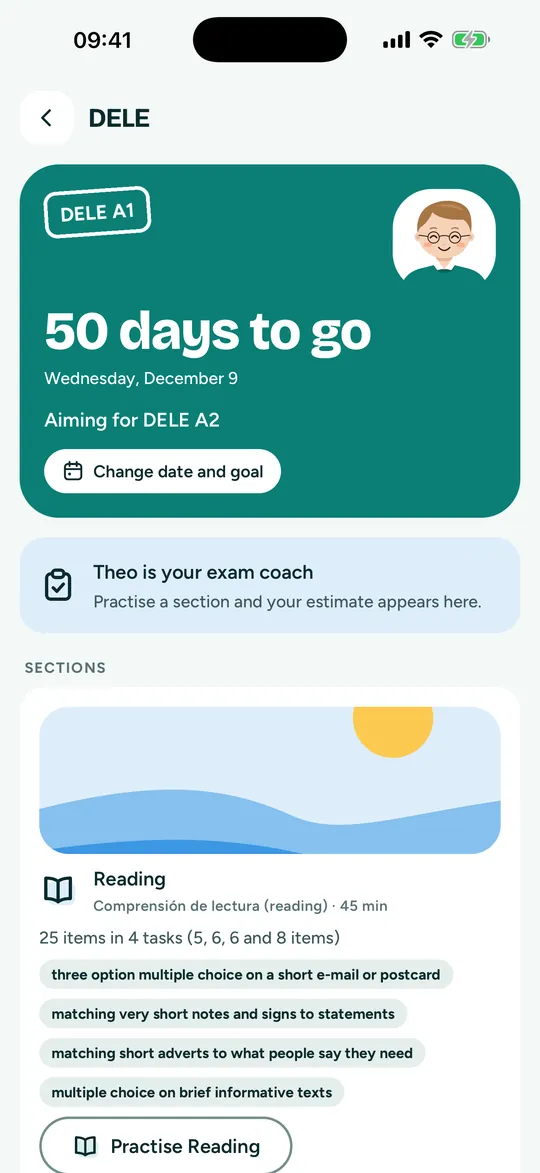
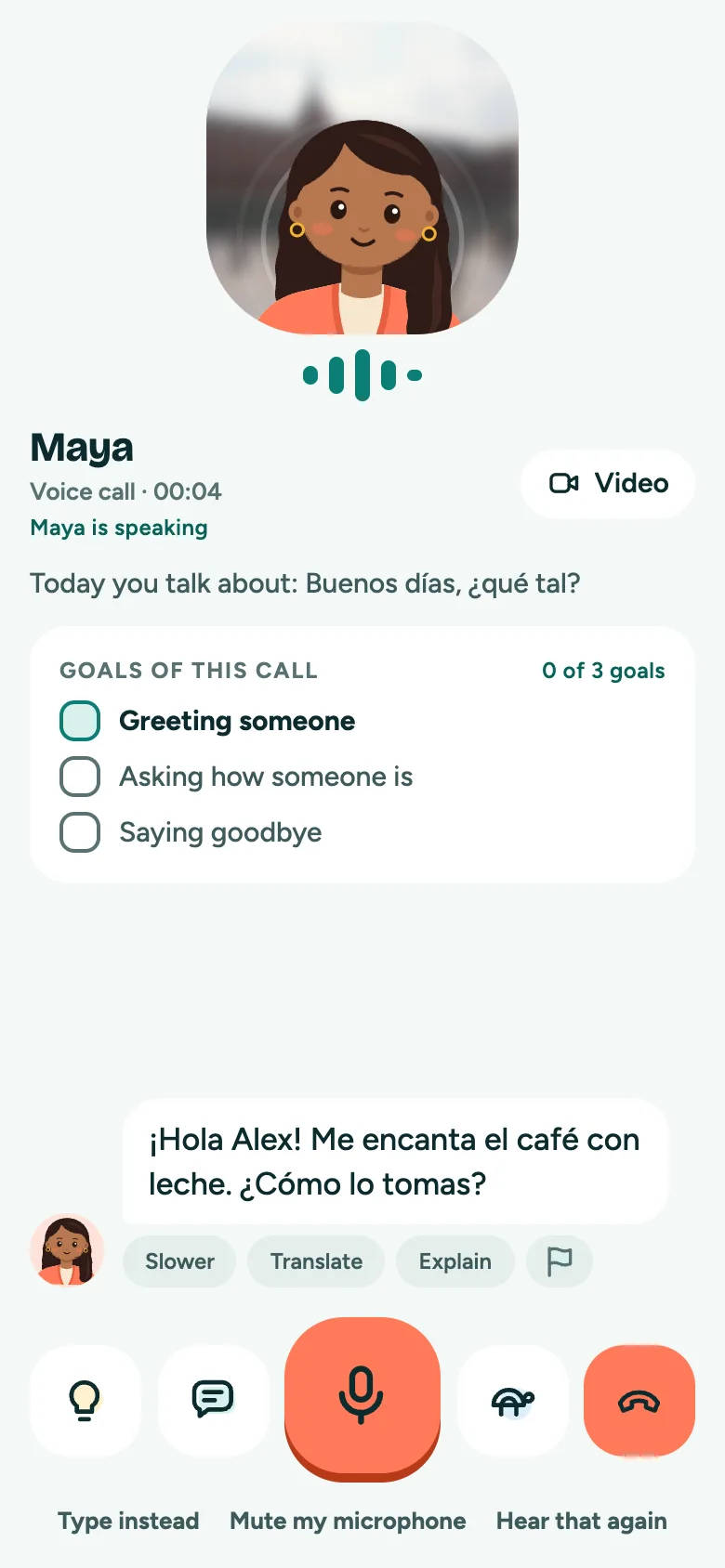
You get natural English from the besties, and lessons can be explained in any of six languages (English, Spanish, French, German, Japanese or Korean), so you can ask "why is this wrong?" in your own language. The interface comes in 15 languages. For the daily volume that makes the difference, the app gives you a partner who is available at the hour you have. As a final step before the real test, book a mock with a qualified teacher or examiner for a human opinion on your answers.
Start practicing today: 7 days free on the yearly plan. Get LingoBestie If you are deciding which app suits your overall English, see the best app to learn English and our wider ranking of language learning apps. To see how AI partners compare with human teachers, read AI tutor vs human tutor and how an AI language tutor works.
How to improve IELTS speaking
If you want a short answer, do these four things in this order.
- Find your weakest criterion. Record one Part 2 answer and use the band table above to judge fluency, vocabulary, grammar and pronunciation separately.
- Drill one criterion for a week. Use the matching drill, not all four.
- Raise your volume. Aim for at least 20 minutes of recorded speaking most days. Volume with feedback is what changes the recording.
- Test under exam conditions. Do a timed mock every week in the last month, and repeat the one that went worst.
Free official practice
- British Council free IELTS speaking practice, the official free practice resource.
- British Council TakeIELTS speaking tips videos, official tips and sample material from IELTS experts.
- IELTS.org speaking format page for the official format and rules (Source 1). The General Training Speaking page is Source 4.
Test day checklist
- The night before: pack your ID, check your location and arrival time, and do one light 10 minute warm up. No new vocabulary.
- Morning: speak English for 15 minutes before you leave, even to yourself, so your voice is warm.
- At the centre: speak English with anyone you meet while waiting.
- In the room: greet the examiner and smile. Sit comfortably and speak at a normal volume.
- If you do not understand a question: say "Sorry, could you repeat that?" Silence helps nobody.
- If you make a slip: correct it briefly if you notice, and carry on. Do not restart the whole answer.
- In Part 2: use all of the minute, write five words, and talk until the examiner stops you.
- In Part 3: give a reason with every opinion.
- After you leave: rest. You cannot change anything now.
FAQ
How is IELTS Speaking scored, and what is a good score?
Examiners mark four equally weighted criteria, and the average gives your Speaking band. Speaking counts for a quarter of your Overall band (Source 5). A good score is the one your university, employer or visa requires, so check that requirement first.
How long should my Part 2 answer be?
Aim to speak close to the full two minutes. The format allows up to two, and a very short answer gives the examiner little to assess for fluency (Source 8). The examiner stops you at the time limit, so a talk that is a little short is not a disaster. Practice with a timer until the length feels natural.
Can I take notes in Part 2?
Yes. The examiner gives you a pencil and paper for the one minute of preparation (Source 1). Write keywords, not sentences.
What if I do not know the topic in Part 2?
You cannot change the card (Source 6), but you can choose which story to tell. Pick the nearest real or invented experience, and use your scene, moment and feeling plan.
Can I use idioms?
Yes, when they fit. The band 7 and 8 descriptors mention less common and idiomatic vocabulary used naturally (Source 2). A few well placed ones are better than forcing one into every answer.
Is the test recorded?
Yes. The Speaking test is recorded (Source 1).
Can I take the speaking test on a different day?
Your test centre sets the Speaking time, and some centres schedule it separately from the other sections. Ask your centre when you book.
Does my accent matter in IELTS Speaking?
The pronunciation descriptors are about how easily you are understood and how well you use stress, rhythm and intonation, not about having a particular accent. Clear speech with your natural accent can score highly.
Can I ask the examiner to repeat a question?
Yes. In Part 1 you can ask for a question to be repeated, and the IELTS Liz FAQ says to do it two or three times at most and that it will not affect your score (Source 6). The examiner cannot explain the question.
Is it bad to speak slowly or fast?
Both extremes cause trouble. Very slow speech can lose the listener, and very fast speech can make your words unclear. Aim for a steady, even pace and speak naturally (Source 9).
What if I run out of things to say in Part 2?
Fall back on your five word plan: add a scene, a moment or a feeling you have not used yet. If you really are finished, stop cleanly rather than repeating yourself.
How many hours does it take to improve my speaking score?
It depends on your starting point, and we do not know of an official figure for moving one IELTS band. Steady practice over weeks or months is the usual pattern, and a focused four week plan can lift a specific weakness such as long turns or abstract answers. For general timelines, see how long it takes to learn a language.
Is the speaking test the same for IELTS Academic and General Training?
Yes. The Speaking test has the same format and the same scoring criteria for both.
Can an AI conversation partner prepare me for the speaking test?
Yes. It gives you the thing most learners lack, which is volume: many more answers out loud than a weekly lesson allows. Finish with a mock with a qualified teacher or examiner. For a longer comparison, see AI tutor vs human tutor.
About this page
Written by the LingoBestie editorial team. The format, scoring rules and criteria come from the official IELTS pages listed below, last checked November 2026. The model answers are original teaching samples written to show the features of the public band descriptors. Statements about LingoBestie describe the app as it works today.
Sources
- IELTS. IELTS Academic format: Speaking. https://ielts.org/take-a-test/test-types/ielts-academic-test/ielts-academic-format-speaking (checked November 2026).
- IELTS. Speaking band descriptors (public version, Academic and General Training). https://ielts.org/cdn/ielts-downloadable-assets/ielts-guidance-and-support/ielts-guides/ielts-speaking-band-descriptors.pdf (checked November 2026)
- British Council. How does the video-call speaking test work? https://www.britishcouncil.my/exam/ielts/better-ielts-test-experience-video-call-speaking (checked November 2026)
- IELTS. IELTS General Training format: Speaking. https://ielts.org/take-a-test/test-types/ielts-general-training-test/ielts-general-training-format-speaking (checked November 2026)
- IELTS. IELTS scoring in detail. https://ielts.org/take-a-test/your-results/ielts-scoring-in-detail (checked November 2026)
- IELTS Liz. IELTS Speaking Frequently Asked Questions. https://ieltsliz.com/ielts-speaking-frequently-asked-questions/ (checked November 2026)
- Swan, M. and Smith, B. (eds). Learner English: A teacher's guide to interference and other problems, 2nd edition. Cambridge University Press, 2001.
- IELTS Liz. Will I get a low score if I speak for less than 2 minutes in Part 2? https://ieltsliz.com/ielts-speaking-part-2-will-i-get-a-low-score-if-i-speak-for-less-than-2-mins/ (checked November 2026)
- IELTS Liz. Should I speak fast or slow? https://ieltsliz.com/should-i-speak-fast-or-slow/ (checked November 2026)