
On this page
- What the DELE is and who accepts it
- Choose your level: A1, A2, B1, B2, C1 or C2
- DELE exam format by level: components, durations and tasks
- Scoring and pass marks as published by the Cervantes
- Strategy by component
- The 12 week plan to A2 and B1
- DELE practice tests: how LingoBestie practises the DELE
- DELE exam cost and when to sit
- Test day checklist
- FAQ
- How we put this guide together
- Sources
The headline facts about the DELE fit in one line: six levels, no expiry date, issued by the Instituto Cervantes. The part that decides your result is how the points are built, which task deserves practice on which day, and how much time a candidate needs.
This guide starts from the official papers and works forwards. You get the format of the A1 to B2 exams in one table, the pass rule explained with a worked example, a strategy for each of the four tests, a 12 week plan for A2 and B1, and a test day checklist. Figures carry a check date, and where sources disagree we say so.
Quick facts (checked October 2026) | Item | Detail | | :- | :- | | Levels | A1, A2, B1, B2, C1, C2 (they match the CEFR levels) | | Tests | Reading, listening, writing, speaking at A1 to B2; C1 and C2 are structured differently | | Issued by | Instituto Cervantes, on behalf of Spain's Ministry of Education and Vocational Training | | Validity | The diploma does not expire | | Pass rule | APTO: at least 30 of 50 points in each of two groups (reading plus writing, listening plus speaking) | | Fees | 2026 fees in Spain run from 112 euros (A1) to 240 euros (C2); see the fee table | | Next registration | 2027 registration opens on 18 November 2026 (official calendar) | | Where to register | The Instituto Cervantes online shop (tienda.cervantes.org) or your accredited centre | | Official page | cervantes.org/es/examenes/dele |
What the DELE is and who accepts it
DELE stands for Diplomas de Español como Lengua Extranjera. The Instituto Cervantes describes them as the official Spanish diploma it awards on behalf of the Ministry of Education, and says (our translation) that the diplomas certify a person's Spanish "officially worldwide, and for ever" (Cervantes FAQ, checked October 2026). The diploma does not carry an expiry date, so a DELE you earn at 22 is still valid at 52. Some institutions ask for a recent certificate anyway, so check their rules.
Who actually asks for it:
- Universities in Spain and Latin America often ask for B2 or C1 as proof for degree programmes taught in Spanish. We found no single official list, so ask your faculty for the exact level.
- Employers and recruiters commonly treat B2 as the point where you can work in Spanish with confidence.
- Spanish nationality applicants are asked for a DELE A2, together with a separate citizenship knowledge test, the CCSE (Legal Team, checked October 2026). This is why A2 has the most dates in the calendar: the 2027 calendar lists A2 sessions in March, April, May, July, September, October and November (Cervantes, checked October 2026).
- Some school and exchange programmes ask for A2 or B1 as evidence of level. Check each programme's rules.
You choose your level when you register, and we found no rule in the Cervantes pages we read that requires an earlier level first, so a B1 candidate does not need an A2 diploma. Confirm with your centre. The exam measures the level you register for.
Choose your level: A1, A2, B1, B2, C1 or C2
The wrong level is the most expensive mistake in this process, because the fee is paid up front and the next sitting may be months away. Pick the level at which you can already do most of the tasks, not the one you wish you had.
| Level | What a candidate can do | Typical reason to sit it | Time on paper |
|---|---|---|---|
| A1 | Fill in a form, understand very short notes, introduce yourself and ask basic questions | First proof of progress, school programmes | 100 min plus 10 min speaking preparation |
| A2 | Handle shopping, directions, simple letters and plans; describe your day in linked sentences | Spanish nationality, first certificate | 157 min plus 12 min speaking preparation |
| B1 | Cope with most travel and work situations, narrate and give opinions, write 100 to 150 word texts | Study abroad, work in Spanish | 185 min plus 15 min speaking preparation |
| B2 | Follow a radio interview, argue a position, write a structured formal letter | University entry, professional work | 210 min plus 20 min speaking preparation |
| C1 | Work and study with fluent, flexible Spanish | Postgraduate study, teaching, translation | See the current Cervantes C1 guide* |
| C2 | Near-native precision and nuance | Academic and linguistic careers | See the current Cervantes C2 guide* |
*The detailed tables in this guide cover A1 to B2, the levels most candidates sit. C1 and C2 have their own structure and timings, so take them from the current guides on the Cervantes DELE page (the 2024 editions of the C1 and C2 guides are the latest we know of; we could not open them in October 2026).
Mini quiz: which level should you aim at?
Count how many of these you could do tomorrow, in Spanish, without a dictionary.
| # | I can... |
|---|---|
| 1 | Introduce myself, say where I live and what I do, and fill in a registration form |
| 2 | Order in a restaurant, buy a ticket and ask someone for directions without switching to English |
| 3 | Write a 70 word message inviting a friend, with day, place and time |
| 4 | Tell a story from last weekend in the past tenses and give my opinion about it |
| 5 | Argue for or against a proposal for two minutes, weighing advantages and drawbacks |
| 6 | Follow a 7 minute radio interview on a social topic and note the speaker's attitude |
| Yeses | Aim at |
|---|---|
| 0 or 1 | A1 (and give yourself 3 to 4 months) |
| 2 or 3 | A2 |
| 4 | B1 |
| 5 or 6 | B2 (C1 only if you also read newspaper editorials comfortably) |
If you are between two levels, take the lower one when the deadline is firm (nationality, a course start) and the higher one when you can retake. The 12 week plan below is built for A2 and B1, the levels where most candidates can prepare within a short window.
DELE exam format by level: components, durations and tasks
This is what the Instituto Cervantes guides specify for the adult general exams, A1 to B2. These figures come from our reading of the official guides on 13 October 2026; the old examenes.cervantes.es pages now redirect to cervantes.org, so confirm timings in the current guide before you register. Reading, listening and writing are taken together on one day; the speaking test may be the same day or a nearby one.
DELE A2 exam and the other levels, side by side
| Level | Reading | Listening | Writing | Speaking |
|---|---|---|---|---|
| A1 | 45 min, 4 tasks, 25 items | 20 min, 4 tasks | 25 min, 2 tasks | 10 min, 3 tasks (10 min preparation) |
| A2 | 60 min, 4 tasks, 25 items | 40 min, 4 tasks, 25 items | 45 min, 2 tasks | 12 min, 3 tasks (12 min preparation) |
| B1 | 70 min, 5 tasks, 30 items | 40 min, 5 tasks, 30 items | 60 min, 2 tasks | 15 min, 4 tasks (15 min preparation) |
| B2 | 70 min, 4 tasks, 36 items | 40 min, 5 tasks, 30 items | 80 min, 2 tasks | 20 min, 3 tasks (20 min preparation) |
- Reading
- Listening
- Writing
- Speaking
| Reading | Listening | Writing | Speaking | |
|---|---|---|---|---|
| A1 | 45.0 | 20.0 | 25.0 | 10.0 |
| A2 | 60.0 | 40.0 | 45.0 | 12.0 |
| B1 | 70.0 | 40.0 | 60.0 | 15.0 |
| B2 | 70.0 | 40.0 | 80.0 | 20.0 |
In the chart, reading stops growing after B1 while writing keeps climbing. The jump from 60 to 80 minutes at B2 is where candidates run out of time, not out of Spanish. Listening stays at 40 minutes from A2 to B2, and every recording is played twice.
Sources disagree on A1 listening. The Cervantes structure and duration sheet (2020, hosted by the Universidad Complutense) gives 20 minutes, and its totals add up: 45 + 20 + 25 + 10 + 10 minutes of preparation is the 1 h 50 min it states. Some older preparation books give 25 minutes. We use 20. If your centre's paperwork says otherwise, follow the centre.
The A2 exam (DELE A2) is the one most candidates ask about. Its four tests total 157 minutes on paper (60 reading, 40 listening, 45 writing and 12 speaking, plus 12 minutes of speaking preparation), with 25 items each in reading and listening, 2 writing tasks of 60 to 70 and 70 to 80 words, and 3 speaking tasks.
Can you take the DELE on computer or online?
The guides we read describe a paper exam held at an exam centre, with registration done online. We found no online-proctored DELE and no general computer-based format on the Cervantes pages. SIELE, the other Spanish certification, is the one that is taken on a computer. Ask your centre which arrangements apply at your sitting.
The tasks in one view
| Level | Reading tasks | Listening tasks |
|---|---|---|
| A1 | Multiple choice on a postcard; match 6 notes or signs to statements; match people to adverts; multiple choice on a notice text | Short dialogues; messages matched to pictures; one speaker matched to sentence endings; a conversation with a gap list |
| A2 | Multiple choice on a letter; one question on each of 8 short texts; match 6 statements to 3 texts; multiple choice on a narrative | Six informal conversations; six radio items; man, woman or neither on a conversation; seven messages matched to ten statements |
| B1 | Match people to texts; informative text; match to 3 accounts; insert missing sentences; grammar gap fill in a letter | Six monologues; a personal experience; news items; six speakers matched to statements; man, woman or neither |
| B2 | Long informative text; match 10 statements to 4 accounts; insert 6 of 8 fragments; 14 grammar and vocabulary gaps in a literary text | Six conversations; man, woman or neither; interview; six speakers matched; lecture or speech |
Scoring and pass marks as published by the Cervantes
Each of the four tests is worth 25 points, 100 in all. The tests are grouped in two:
- Group 1: reading plus writing (50 points)
- Group 2: listening plus speaking (50 points)
To obtain the APTO you need at least 30 of the 50 points in each group. There is no overall mark that rescues a weak group. The diploma has no numerical grade, only APTO or NO APTO.
A candidate who scores reading 22 and writing 6 has 28 points, below the line, so Group 1 fails even though 22 of 25 in reading is excellent. Another who scores reading 15 and writing 15 has 30 and passes, despite being much weaker in reading. A very good test does not offset a poor one in the same group, but two average tests do pass. Keep writing in your plan even if reading is your strength.
Worked B1 example. B1 reading has 30 items. If you answer 21 correctly, the raw score is 21 and it is scaled as 21 x 25 / 30 = 17.5 points, which is 70 percent of the reading test. If your writing then scores 12.5 of 25 (50 percent), Group 1 totals 30 and passes. The same 21 correct answers with writing at 10 gives 27.5, which fails. Writing at 12.5 is therefore the lowest you can afford with a 70 percent reading result.
How each test turns into points:
| Test | How the points are made |
|---|---|
| Reading and listening | One point per correct answer, no penalty for wrong ones, scaled to 25. At B1 the raw score is multiplied by 25 and divided by 30. |
| Writing | Trained raters score each task against published scales (task fit, coherence, range and control of language). The exact weights are in the current Cervantes guide for your level, which we could not open in October 2026, so we do not quote them. |
| Speaking | An interviewer and a second rater score the test on published scales, with preparation time and notes allowed. Read the current guide for the weights. |
Because there is no penalty for wrong answers in reading and listening, a blank is always a lost point. Never leave an item empty.
Strategy by component
Comprensión de lectura
The reading test is partly a time test. At A2 you have 60 minutes for 25 items, which is under two and a half minutes each, but the tasks differ a lot in length, and the usual mistake is to give the early tasks more time than they deserve.
1. Do the matching tasks first at B1 and B2. Tasks that ask you to match people to texts or statements to accounts reward a quick first pass. Read the statements before the texts, underline the one specific detail in each (a day, a price, a condition), then scan the texts for it. Cross out a text as soon as you use it, but remember that some tasks include texts that are not used.
2. Questions come in text order. In the multiple choice tasks, the questions follow the order of the text. Read question 1, find the sentence, answer it, and move on. Do not read the whole text twice.
3. Learn the distractor patterns (a core DELE B2 tip as well as an A2 one). In three option questions, the wrong options usually do one of three things: they use the exact words of the text but say something different, they are true in the text but do not answer the question, or they go further than the text (always, nobody, everything). A sample:
Marta escribe a su prima porque... a) quiere visitarla en agosto. b) necesita que le preste una maleta. c) le cuenta que se va a mudar.
If the email says el mes que viene me mudo a Valencia y, si quieres, en agosto vengo a verte, then a) is a plan mentioned in passing, c) is the reason for writing. Main idea questions at A2 Tarea 1, a letter or email with 5 three-option questions, are often about why someone writes.
4. The insertion tasks (B1 Tarea 4, B2 Tarea 3) are about links, not vocabulary. Look at what each fragment begins with (Por eso, Sin embargo, Esto, a pronoun) and what comes before each gap. A fragment that starts with Esto needs a noun phrase to refer back to. At B2 two fragments are decoys.
5. The grammar gap fills (B1 Tarea 5, B2 Tarea 4) pay for grammar you have actually drilled. At B2 they are 14 of the 36 reading items, nearly 40 percent, so strong grammar can swing the whole test. Typical targets: ser against estar, por against para, subjunctive after aunque and cuando, pronoun order (se lo dije), prepositions after verbs (acordarse de, soñar con).
Time split we suggest at B1 (70 minutes): 10 for Tarea 1, 15 for Tarea 2, 12 for Tarea 3, 15 for Tarea 4, 10 for Tarea 5, and 8 minutes in hand to transfer answers. The answer sheet is read by a machine, so transferring carefully matters.
Comprensión auditiva
Every recording is played twice. That changes the strategy: the first listening is for gist and structure, the second is for the exact answer. Do not try to catch everything the first time.
Use the preparation pause. Before each task you get time to read the questions. Use it to predict. In a "man, woman or neither" task (A2 Tarea 3, B1 Tarea 5, B2 Tarea 2), mark each statement M, W or N in pencil on the first listening, then confirm on the second. "Neither" is a real option, and it is correct more often than candidates expect, when the statement mixes a fact from one speaker with an opinion of the other.
Write only numbers, names and verbs. If an item asks for a time, a price or a place, note the figure and the preposition next to it (a las ocho y media, en la segunda planta). Trying to write whole sentences means you miss the next sentence.
The B1 and B2 matching tasks have a trap. When six speakers are matched to a longer list of statements, a statement is often paraphrased, not quoted. A speaker says Me costó un montón decidirme and the right answer is "dudó mucho antes de decidir". Read the options for meaning, not for words.
Accents. The recordings use speakers from several Spanish speaking countries. If you have only heard one variety, spend two weeks of your plan on listening to the others: Rioplatense ll and y, the Caribbean dropped s, the Andean slower rhythm, northern Spain's z and c.
Expresión e interacción escritas
Raters read two short texts and score them on published scales. You do not need beautiful Spanish; you need the right text type, every guidance point covered, and enough control to be understood without effort.
| Level | Task 1 | Task 2 |
|---|---|---|
| A1 | Fill in a form (15 to 25 words in all) | Message of 30 to 40 words with greeting and farewell |
| A2 | Reply of 60 to 70 words to a letter, note or invitation | 70 to 80 words on one of two options (everyday topic, or a biography or narrative from photos or data) |
| B1 | Letter or message of 100 to 120 words | 130 to 150 words (composition, diary entry or biography) from a news item |
| B2 | Formal or informal letter of 150 to 180 words, built on a recording heard twice | Formal opinion text of 150 to 180 words, from a chart or a short article |
Cover every point. Each task lists guidance points. A missed point costs you in the first scale (fit to the task) and nothing else makes up for it. Number the points on the paper before you write and tick them off.
Respect the word count. Fewer words than the minimum usually means the task is incomplete. Far more is a risk, because every extra line is another place for errors. Aim for the middle of the range.
Prepare four reusable frames. For A2 and B1, memorise the openings and closings in the right register. Informal: Hola, Lucía: ¿Qué tal estás? Te escribo para... and Un abrazo, Marcos. Formal: Estimado señor Pérez: and Le saluda atentamente, Marcos Ruiz. Use usted from the first line in the formal one and do not slip back to tú; mixing registers is the commonest quiet error in B1 and B2 letters.
A model A2 answer (61 words, inside the 60 to 70 range) to an invitation to a friend's birthday:
Hola, Marta: Muchas gracias por la invitación. Me encantaría ir a tu fiesta, pero el sábado por la tarde tengo que trabajar hasta las siete. Puedo llegar a las ocho, si te parece bien. ¿Qué quieres que lleve, algo de beber o un postre? Si prefieres, también puedo ayudarte a preparar la comida por la mañana. Avísame pronto. Un abrazo, Sara.
Count the guidance points it covers: thanks, accept, a problem, an alternative time, an offer. Raters look for exactly this kind of coverage.
B2 task 1 is a listening task in disguise. You hear a recording of 200 to 250 words twice while taking notes, then write a letter that uses its content and gives an opinion. Practise note taking in a three column grid (fact, number, opinion) so the letter writes itself.
Expresión e interacción orales
The speaking test worries many candidates, and it is also the most predictable. You get preparation time (10, 12, 15 or 20 minutes depending on level), notes are allowed, and the examiner sticks to a script.
| Level | Tasks | What the examiner wants |
|---|---|---|
| A1 | Identity monologue (1 to 2 min); everyday topic monologue (2 to 3 min); questions, then you ask two prepared questions (3 to 4 min) | Clear simple sentences, all points covered |
| A2 | Prepared monologue on a topic (2 to 3 min); photo description (2 to 3 min); simulated situation (3 to 4 min) | Linked sentences, past and future, a real transaction |
| B1 | Prepared presentation (2 to 3 min); conversation on it (3 to 4 min); photo and questions (2 to 3 min); role play (2 to 3 min) | Opinion and experience with reasons |
| B2 | Weigh up 5 to 7 proposals, then discuss (6 to 7 min); imagine a situation from a photo (5 to 6 min); discuss survey results (3 to 4 min) | Structured argument, nuance, interaction |
Example prompts in our own words (not copied from any official paper):
- A2, task 2: A photo of a market stall. Describe lo que ve: ¿dónde están las personas?, ¿qué hacen?, ¿qué compra la mujer? ¿Le gusta ir al mercado?
- A2, task 3: Usted está en una tienda de ropa y quiere cambiar unos pantalones que le quedan pequeños. El examinador es el dependiente.
- B1, task 1: El trabajo ideal. Hable de cómo sería, qué es más importante (el sueldo, el horario, el ambiente), su experiencia y qué cambiaría.
- B2, task 1: Los pueblos pequeños pierden habitantes. Se proponen seis ideas para frenar el problema. Elija las tres que le parezcan más útiles y explique por qué.
What to write in the preparation time. Keywords only. Candidates who write full sentences end up reading them out, which scores lower on fluency than a slightly imperfect spoken answer. For a monologue, write the opening line, three headings and the closing line.
Use time frames. At A2 the quickest gain is to place one verb in each of three tenses: ayer fui (preterite), normalmente voy (present), el año que viene voy a ir or iré (future). At B1 add me gustaría and creo que. At B2 add concession: aunque sea caro, merece la pena; por un lado..., por otro....
For the role play, do the job. Examiners want to see you carry out the task: get the refund, book the appointment, solve the problem. If you do not understand, ask: ¿Puede repetirlo, por favor?, which is a perfectly good answer and scores better than silence. If you do not know a word, describe it: esa cosa para cortar papel instead of tijeras.
Our guide on how to practise speaking a new language covers the habit side of this, and the IELTS speaking practice guide shows how a sibling exam handles the same timed-speaking skill. For the DELE, rehearse under the clock.
DELE B2 tips
- Treat the written tests as a stamina event: they run 3 h 10 min in all.
- Take the 14 grammar and vocabulary gap items in reading seriously, since they are nearly 40 percent of that test.
- In writing task 1, take notes from the recording in a fact, number, opinion grid.
- In speaking, practise weighing proposals aloud with concession phrases such as por un lado..., por otro....
The 12 week plan to A2 and B1
This plan assumes you already work at about the level below the target, which is how most candidates arrive. Starting from zero? A2 usually needs more than 12 weeks; our guide to how long it takes to learn a language puts the road in context. The hours below are a plan designed by LingoBestie, not an official figure and not a promise. For the wider course around the exam, see our best app to learn Spanish guide.
| Weeks | Focus | A2 track hours per week | B1 track hours per week |
|---|---|---|---|
| 1 | Diagnose: take one full practice paper under timing, mark by test | 5 | 6 |
| 2 | Reading tasks 1 and 2: main idea, scanning | 5 | 6 |
| 3 | Listening tasks: gist, then detail; one new accent | 5 | 6 |
| 4 | Writing task 1: frames, guidance points, 3 short texts | 6 | 7 |
| 5 | Speaking: monologue structure and time frames | 6 | 7 |
| 6 | Mid check: second full paper, compare with week 1 | 6 | 8 |
| 7 | Grammar that costs points: past tenses, ser and estar, por and para | 6 | 8 |
| 8 | Reading matching and gap tasks; vocabulary of daily life and work | 6 | 8 |
| 9 | Speaking role plays and photo description, recorded | 7 | 9 |
| 10 | Writing task 2 under the clock; fix the two most repeated errors | 7 | 9 |
| 11 | Full mock exam, all four tests, same time of day as the real one | 7 | 9 |
| 12 | Review the errors, light practice, rest, test day checklist | 4 | 5 |
The A2 track adds up to 70 hours and the B1 track to 88 hours.
How to split a week: about 40 percent on the weakest test, 30 percent on listening and speaking (they sit in the same group), 20 percent on reading and writing, and the rest on grammar and review. The ratio changes in week 6 after your second paper tells you where the points actually are.
Use your week 1 paper to set the schedule. If it shows under 40 percent in two tests, book a later session and stretch the plan; the registration calendar has several dates a year. If you are already near 60 percent in three of four tests, compress the plan to 8 weeks and keep the final mock.
If you want a place to run these weeks, LingoBestie has a 7 day free trial on the yearly plan, with no payment today, and the exam section below is built for steps like the week 1 diagnostic.
DELE practice tests: how LingoBestie practises the DELE
LingoBestie is an iOS first language app with six courses (English, Spanish, French, German, Japanese, Korean). Lessons are explained in any of those six languages, and the app interface comes in 15 languages. For Spanish learners, the exam section is built from the official formats:
- Four levels, A1 to B2. Each has a full mock exam plus practice sets for each test. We counted 336 DELE tasks in the content files on 1 November 2026 (78 at A1, 78 at A2, 96 at B1 and 84 at B2, including 56 mock tasks), and the mock exam for each level follows the real task order.
- Feedback on every answer. You see why an option is wrong, not only that it is.
- Task types as in the guides. Matching, multiple choice, insertion of fragments, man or woman or neither, form filling, letters, photo description, role play. Our tasks are written from the published specifications in our own words, with no copying of official papers.
- Speaking and writing practice with models. The speaking sets give the preparation time and the speaking time, and each speaking task has a model answer at the top score (3 puntos) with notes on why it scores well.
- Bestie roleplays for the oral. Maya, the Spanish course's bestie, speaks the Spanish of Spain in lessons and is your conversation partner in chat and calls. The roleplay scenes (a doctor visit, a shop and similar everyday scenes) are situations of the kind A2 and B1 role plays use. The bestie is an AI friend and says so warmly when you ask.
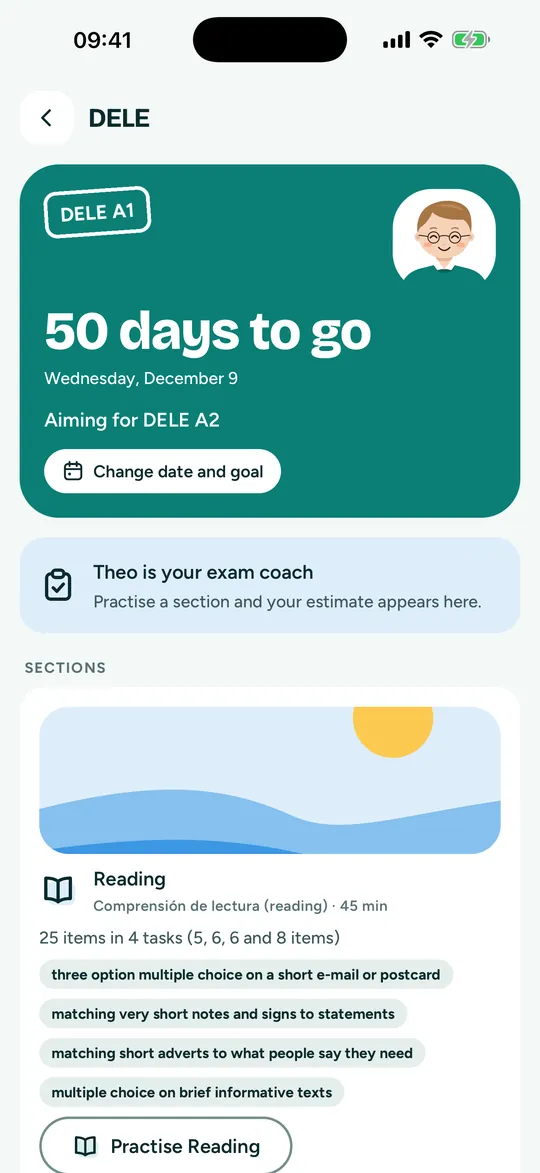
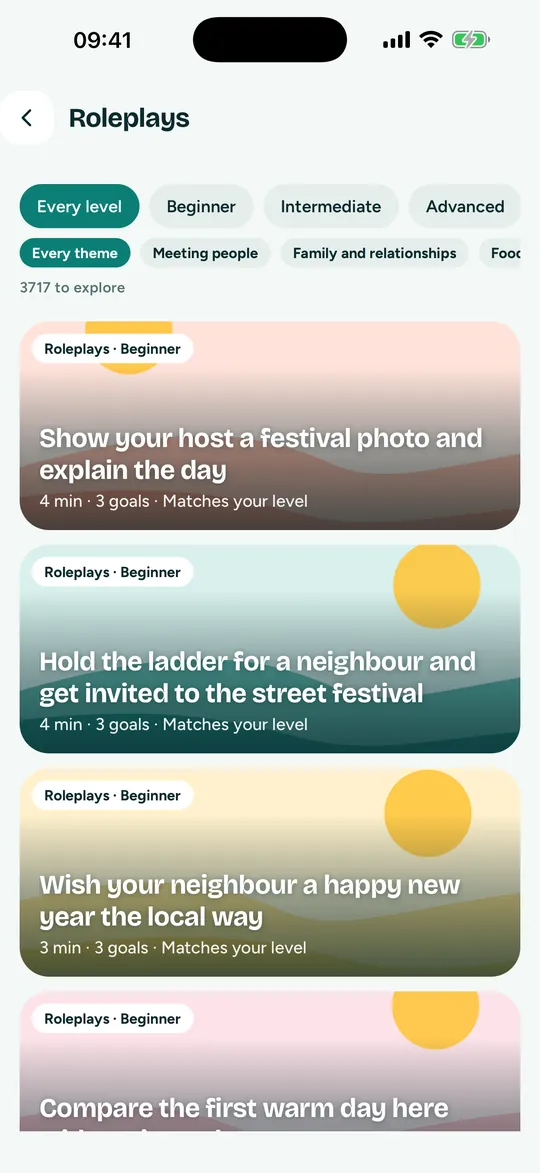
LingoBestie covers the four levels most candidates sit, A1 to B2, and the official Cervantes sample papers are a good companion for any level, including C1 and C2. Learning in LingoBestie needs Plus, and the yearly plan starts with a 7 day free trial with no payment today, so you can try a full mock before you decide. Only the Instituto Cervantes awards the diploma. Our best language learning apps ranking shows how the app compares on speaking and exam preparation.
Self-study, school course or app?
| Route | Strength | Watch out for |
|---|---|---|
| Self-study with official papers | Free, exactly the real format | No feedback on writing or speaking unless you find a reader |
| School or centre course | A teacher marks your work and sets a deadline | Centre prices vary, and many courses charge by the week |
| LingoBestie | Practice by test on a phone, feedback on every answer, bestie roleplays for speaking | Plus subscription; use the Cervantes papers alongside it for the final full-length run |
Official practice materials
The Instituto Cervantes publishes sample papers, audio files and answer keys for each level, and the guides we read in October 2026 pointed to them. Start from the Cervantes DELE page (the old examenes.cervantes.es practice page now redirects there). Do one full official paper under timing in week 1 of the plan and another in week 11.
DELE exam cost and when to sit
Fees are set each year by the Cervantes; outside Spain they differ by country. The 2026 schedule published for Spain:
| Level | 2026 fee in Spain |
|---|---|
| A1 | 112 euros |
| A2 | 138 euros |
| B1 | 173 euros |
| B2 | 204 euros |
| C1 | 225 euros |
| C2 | 240 euros |
Source: Universidad de Leon summary of the Instituto Cervantes fees, checked October 2026. The A2 fee rose to 138 euros, as reported by Legal Team on 4 December 2025. 2027 fees were not published when we checked, so refresh this page after 18 November 2026.
Preparation courses are priced separately by each school and are not part of the exam fee, so confirm the exam fee on the official shop at registration.
Dates (Cervantes calendar, checked October 2026): registration for 2026 is closed (the last general session, on 13 and 14 November 2026, closed on 30 September). The 2027 registration opens on 18 November 2026, and the calendar lists, for example, written tests on 5 March 2027 (registration closes 20 January 2027) and on 12 and 13 November 2027 (registration closes 29 September 2027). Not every level is offered in every session: A2 has the most dates in both 2026 and 2027, and the main sessions run all six levels. Read the table on the Cervantes page for your level.
Results and retakes. The Cervantes publishes results in the candidate's personal area of its online shop. We do not quote a waiting time, because it varies by session. We also found no Cervantes statement, in the pages we could read, that lets you retake only the group you failed, so plan on registering for the full exam again and confirm with your centre.
DELE Escolar (under 18s). The 2027 calendar lists school sessions on Friday 21 May and Friday 12 November, for A1, A2/B1 and B2/C1 (Cervantes, checked October 2026). The A2/B1 school exam leads to either diploma depending on the score, and is aimed at learners of about 11 to 17 (FEDELE, checked October 2026). Parents or guardians register minors.
Test day checklist
- The night before: pack your ID, the registration confirmation and two pencils or pens that work. Check the centre's rules on pencils for the answer sheet.
- Arrive early. Your centre's convocation letter gives the exact time; do not cut it fine.
- Phones off and put away. Not on silent; off.
- Write your answers on the answer sheet as you go, not only in the last five minutes.
- Reading: matching tasks first at B1 and B2, grammar gap fills last.
- Listening: use the pause before each recording to predict, mark in pencil on the first play, confirm on the second.
- Writing: number the guidance points, hit the word count, check registers once.
- Speaking: use preparation time for keywords, not sentences. If you freeze, say Perdone, ¿puede repetirlo? and restart.
- Between tests: eat something and drink water. The B2 written tests alone run 3 h 10 min.
- After: check your results in the personal area of the Cervantes shop.
FAQ
How long does it take to prepare for the DELE?
It depends on where you start. Our plan assumes 70 hours for A2 and 88 hours for B1 over 12 weeks for a candidate who already works at the level below the target; from zero, A2 takes several months. These are LingoBestie planning figures, not official ones.
Can I take the DELE B1 without passing A2?
Yes. According to the Cervantes materials, you register for the level you want, and earlier diplomas are not a prerequisite. Choose by your real level.
What score do I need to pass the DELE?
You need at least 30 of 50 points in each of two groups: reading plus writing, and listening plus speaking (Cervantes guides, read 13 October 2026). There is no overall average that can replace a weak group.
Does the DELE diploma expire?
No. The Instituto Cervantes describes the diploma as valid for ever. Some institutions ask for a recent certificate, so check their requirements.
How much does the DELE cost?
In Spain in 2026, from 112 euros for A1 to 240 euros for C2 (A2 138, B1 173, B2 204, C1 225). Fees outside Spain differ by country, so check with your centre.
Is DELE B2 hard?
It is a clear step up from B1. Writing grows to 80 minutes, and the B2 tasks ask you to use a recording or chart as source material. Reading has 36 items, 14 of them grammar and vocabulary gaps, so grammar accuracy counts for nearly 40 percent of that test. In speaking you get 20 minutes of preparation and must weigh proposals and argue with nuance. The pass rule is the same as at other levels (30 of 50 per group), and timed practice is what most improves results. The DELE B2 tips above cover each test.
Which is better to get, DELE or SIELE?
They serve different purposes. The DELE is a diploma at one chosen level that does not expire. SIELE is run jointly by the Instituto Cervantes, UNAM, the Universidad de Salamanca and the Universidad de Buenos Aires, reports a score on a scale, and its results are valid for five years according to the 2025 addendum to the agreement between the four institutions (BOE-A-2025-5582, checked October 2026; confirm at siele.org). For nationality applications Spain asks for the DELE A2 specifically.
Where can I find official DELE practice tests?
The Instituto Cervantes publishes sample papers, audio files and answer keys (start at the DELE page), and the LingoBestie exam section gives you full mocks and practice by test for A1 to B2 with feedback on every answer.
Can I take the DELE online?
The Cervantes pages we read describe the DELE as an exam held at an exam centre, with online registration. We found no online-proctored DELE. Confirm the arrangements for your session with your centre.
Can I retake only the failed group?
We found no Cervantes statement that allows it in the pages we could read. Plan on a new registration for the whole exam and ask your centre before you pay.
Which DELE level do I need for Spanish nationality?
A2, together with the separate CCSE citizenship test (Legal Team, checked October 2026). CCSE 2027 registration opens on 23 November 2026 (Cervantes).
How we put this guide together
The format figures come from the Instituto Cervantes exam guides for A1 to B2, which we read on 13 October 2026 and which are also encoded in our DELE practice specifications. On 31 October 2026 we re-checked the fees, the 2027 calendar and the pass rule against the Cervantes DELE page and the University of Leon summary of the Cervantes Governing Body fee schedule, and on 1 November 2026 we re-checked the SIELE, DELE Escolar and delivery points. Where official and third party figures disagreed, we used the Cervantes figure and mentioned the difference. We wrote all example tasks ourselves. The old examenes.cervantes.es exam pages now redirect to cervantes.org, so read the current guide before you register. Refresh this page after 18 November 2026, when 2027 fees should appear.
Sources
All checked October 2026 unless a date is given.
- Instituto Cervantes, DELE page and 2027 calendar: https://cervantes.org/es/examenes/dele
- Instituto Cervantes, frequently asked questions, "What is the DELE": https://cervantes.org/es/preguntas-frecuentes
- Instituto Cervantes DELE A1, A2, B1 and B2 guides, as read on 13 October 2026 at examenes.cervantes.es (these addresses now redirect to the DELE page above, so the figures are from that reading, not a live link)
- Universidad de Leon, DELE prices approved by the Cervantes Governing Body for 2026 and 2026 dates: https://spanish.unileon.es/en/dele.htm
- Legal Team, A2 fee raised to 138 euros, 4 December 2025, and A2 for nationality: https://legalteam.es/el-cervantes-sube-el-precio-del-examen-dele-a2-necesario-para-nacionalidad-espanola/
- FEDELE, DELE Escolares: https://fedele.org/en/dele-para-escolares/
- BOE, 2025 addendum on SIELE (Instituto Cervantes, UNAM, Universidad de Salamanca, Universidad de Buenos Aires; results valid five years): https://www.boe.es/boe/dias/2025/03/20/pdfs/BOE-A-2025-5582.pdf
- Universidad Complutense de Madrid, exam structure sheet 2020 (used only for the A1 listening disagreement): https://ucm.es/data/cont/media/www/pag-93416/DELEEstructura2020.pdf
- LingoBestie DELE practice content and exam specifications, internal, counted 1 November 2026.