
On this page
- What to look for in a Spanish app
- How we compared the apps
- Comparison of eight ways to learn Spanish
- The best free option, and when to pay
- Who each kind of app is for
- LingoBestie Spanish: what you actually get
- Best app to learn Spanish for beginners
- Best app to learn Spanish for travel
- Spain or Latin America: which Spanish will you learn?
- DELE: which level to aim for and how the app practises it
- A 13 week Spanish plan from zero to your first conversation
- Common mistakes of English speakers, and the fix
- Learning Spanish if your own language is French, German, Japanese or Korean
- Our verdict
- FAQ
- Sources
Two questions decide whether you will still be happy with a Spanish app in six months: which Spanish is it teaching you, and when does anything answer you out loud? Many "best Spanish app" lists never ask either one.
This page answers both. It compares eight ways to learn Spanish in 2026, says which variety each one teaches, names the best free option, and ends with a 13 week plan that takes a complete beginner to a first real conversation.
By the LingoBestie team. Competitor facts come from each app's official page, read in October 2026, with the link beside the fact. LingoBestie numbers are reproduced by a script, listed under Sources. LingoBestie is our own app, so we say where another app is the better fit.
Our picks by goal (checked October 2026)
| Your goal | Start here | Why |
|---|---|---|
| Talk with real people, travel, family, work | LingoBestie | Roleplay every session, plus chat and calls |
| Pass the DELE (A1 to B2) | LingoBestie | DELE formats A1 to B2, feedback on answers |
| Latin American Spanish only | Babbel (Mexico course) or Pimsleur | Both publish a Latin American track |
| Best free option | Language Transfer | Free audio course, funded by donations |
| Audio in the car, no screen | Pimsleur | Spoken audio is the whole method |
| A human tutor | Preply | Hourly lessons, tutors from many countries |
LingoBestie is iPhone first. Sign up with an account, then start the yearly plan with a 7 day free trial. If you are on Android today, the other picks above are the ones to start with.
What to look for in a Spanish app
Spanish is one of the easier languages for an English speaker. The US Foreign Service Institute puts it in its fastest group, Category I, at 24 to 30 weeks or 600 to 750 class hours for professional working proficiency (FSI language difficulty, archived copy, checked October 2026). The easy first month is also the risk: people choose an app because it feels pleasant, and never test the five things that matter later.
1. The variety. Spanish is an official language in about 20 countries (list of countries and territories where Spanish is official, checked October 2026; Puerto Rico is co official on top of the 20 sovereign states). For a learner it comes down to two big families. The Spanish of Spain has vosotros, coche and ordenador. The Spanish of Latin America has ustedes as the only plural "you", carro or auto, computadora, and seseo, which means c before e or i and z are both pronounced like s. Everyone understands everyone. But if an app drills one variety and never says which, you find out in a taxi in Bogota or a bar in Seville.
2. What happens to vosotros. An app that silently deletes it leaves you lost in Spanish films, adverts and half of Spain. An app that drills it for a learner going to Mexico wastes a month. The best apps tell you what it is, who uses it, and let you decide how far to take it.
3. Verb help in small pieces. Spanish verbs are where English speakers quit. Look for an app that introduces them in small chunks, inside situations, and brings them back days later. Conjugation tables alone do not stick.
4. Speaking you actually do. Repeating a recorded phrase into a microphone is practice. Answering a waiter who says something you did not expect is a skill. Check whether the app has open conversation, and whether anyone corrects you.
5. A route to an exam, if you want one. The DELE (Diplomas de Español como Lengua Extranjera) is the official Spanish diploma, awarded by the Instituto Cervantes, recognised internationally. If a job, visa or university may ask for it, you want practice in the exact task formats. The levels themselves follow the CEFR (Common European Framework of Reference); the Council of Europe publishes the CEFR level descriptions, checked October 2026.
How we compared the apps
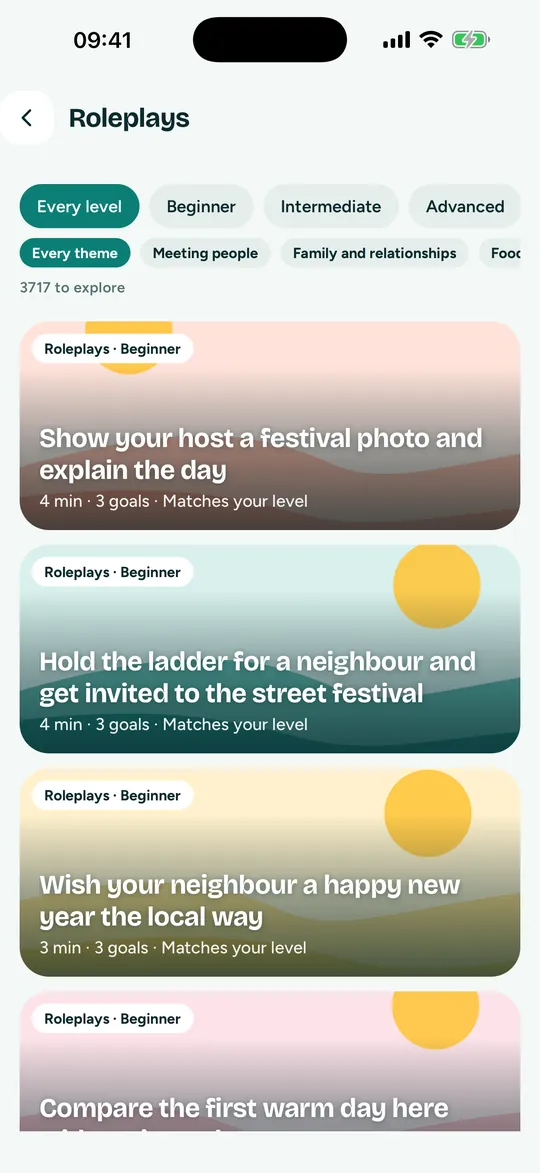
We looked at eight options that learners search for and recommend: LingoBestie, Duolingo, Babbel, Busuu, Pimsleur, Rocket Spanish, Preply and Language Transfer.
In October 2026 we read each official course, help or pricing page and recorded only what the page says: which variety it teaches, the CEFR range it claims, whether speaking happens with a person, a recording or software, whether there is exam practice, and how it charges. Where an official page did not state something, the table says so instead of filling the gap from third party sites. Prices move with promotions and country, so treat every figure as a snapshot and click through before you buy.
For LingoBestie we reproduced every course number from the course files with a script (see Sources). The weight in our ranking goes to speaking and to variety clarity, because those two are the ones learners most often regret.
Comparison of eight ways to learn Spanish
| App | Variety | Level range | Speaking | Exam practice | How it charges |
|---|---|---|---|---|---|
| LingoBestie | Spain in the lessons, Latin American forms named in the notes | Pre A1 to B1, 450 sessions | Roleplay each session; chat, voice call and video call with your bestie | DELE format mocks and section sets, A1 to B2 | Plus: $79.99 a year with a 7 day free trial, or $14.99 a month (US prices) |
| Duolingo (Max help page, Video Call post, score post) | Not stated on the pages we read | Duolingo says its most advanced courses reach the end of B2 | Video Call for Max subscribers learning Spanish; Roleplay availability depends on course and tier | None listed | Free with ads; Super and Max are paid. Duolingo shows prices only in the app, so we list none |
| Babbel (Spanish page) | Two courses: Spanish (Spain) and Spanish (Mexico) | Page lists A1 to C1; we could not confirm from Babbel's pages which course reaches which level | Dialogue lessons; Babbel Speak, a beta AI conversation feature | None listed | Subscription; prices are on Babbel's pricing page and vary by plan and country |
| Busuu (Spanish apps page) | Not stated per country | Standard course A1 to B2 | AI Conversations and pronunciation scoring in Premium Plus | Premium Plus has an Advanced Spanish Exam Preparation track; its McGraw Hill certificates are not accredited like DELE or SIELE | Free A1 course; Premium adds the full course; Premium Plus is the higher paid tier; check Busuu's pricing page for current prices |
| Pimsleur (Latin American page, Spain page) | Two courses: Latin American and Castilian | Several levels; bought 30 lessons at a time | Spoken audio, listen and respond | None listed | Free first lesson; price shown on the page at checkout |
| Rocket Spanish (page) | Latin American, with Latin American culture | Three levels plus a "Play the Part" course | Voice recognition and play both sides dialogues | None listed | Lifetime access course; free trial without a card |
| Preply (Spanish tutors) | The tutor's own: Spain, Mexico, Colombia and more | Any level, set with the tutor | Live one to one lessons | Depends on the tutor | Per lesson. Page says classes start from $3 with an average of $17; Spain tutors average $35 an hour, Mexico $27 |
| Language Transfer (Complete Spanish) | Not stated on the page | Beginner course, no CEFR claim | Spoken audio, you answer aloud | None | Free; the site has a Free Courses link and a donation button |
The table shows a split. Preply is about talking with a person. Pimsleur and Language Transfer are about audio drilling. Duolingo, Babbel and Busuu are course apps that have added speaking features on top. LingoBestie combines a structured CEFR course of 450 sessions with a speaking partner in every session, and among the pages we read it is the one that also puts DELE format mock exams for A1 to B2 in the same app. Busuu has an exam preparation track and Duolingo has Video Call, so the difference is the combination in one place, not any single feature.
Where each one wins. Babbel names a Mexico course, so it is the clearest choice if you want Latin American Spanish and nothing else. Pimsleur is hard to beat for a commute. Preply gives you a human, which is worth paying for once you are past A2. Language Transfer is generous and free. Busuu's exam preparation track is a real option for exam learners who prefer a course app. LingoBestie wins on structure plus daily speaking plus a friend who remembers your week, in one place.
Also considered. We left these out of the table because we did not read their official pages for this update: Rosetta Stone (picture based, immersion style lessons), Mondly (short lessons with a chatbot), Memrise (vocabulary practice with clips of native speakers), Tandem and HelloTalk (language exchange with real speakers, where quality depends on your partner) and SpanishDict (dictionary and conjugation reference, handy next to any course).
The best free option, and when to pay
If you want to spend nothing, start with Language Transfer's Complete Spanish: an audio course that teaches you to build sentences by thinking, free to download and funded by donations. Add free Duolingo for daily habit, and a free language exchange on Tandem or HelloTalk for speaking. That combination costs only time.
Paying makes sense when you want one of three things: a structured route with levels (any of the course apps), a patient partner at any hour (LingoBestie), or a human who corrects you (Preply). LingoBestie is a paid app with no free plan, and its yearly plan starts with 7 days free. The sensible test for any paid app is the free trial or free lesson: if you are speaking Spanish aloud inside the first ten minutes, it is built for talking.
Who each kind of app is for
| You are... | Pick | Reason |
|---|---|---|
| An adult who wants to speak | LingoBestie or Preply | You talk to something that answers |
| Commuting, hands busy | Pimsleur or Language Transfer | Audio only |
| Collecting vocabulary | Memrise or a flashcard app | Spaced repetition |
| Wanting immersion in pictures | Rosetta Stone | No translation, picture led |
| On Android today | Duolingo, Babbel, Busuu, Rocket Spanish | LingoBestie is iPhone first |
LingoBestie Spanish: what you actually get
The Spanish course has 450 guided sessions that follow the CEFR from Pre A1 to B1. The split is concrete:
- Sessions
| Sessions | |
|---|---|
| Pre A1 | 30.0 |
| A1 | 60.0 |
| A2 | 195.0 |
| B1 | 165.0 |
Of the 450 sessions, 271 are core lessons, 90 are listening sessions and 89 are review sessions that bring earlier phrases back. Each session takes about 15 minutes, so the full course is about 112 hours of guided practice (450 x 15 minutes), before the chat and call time with your bestie, which is where most learners find their voice. The A2 band is the longest on purpose: past tenses, ser against estar and por against para either click or stall people there, so the course slows down and revisits.
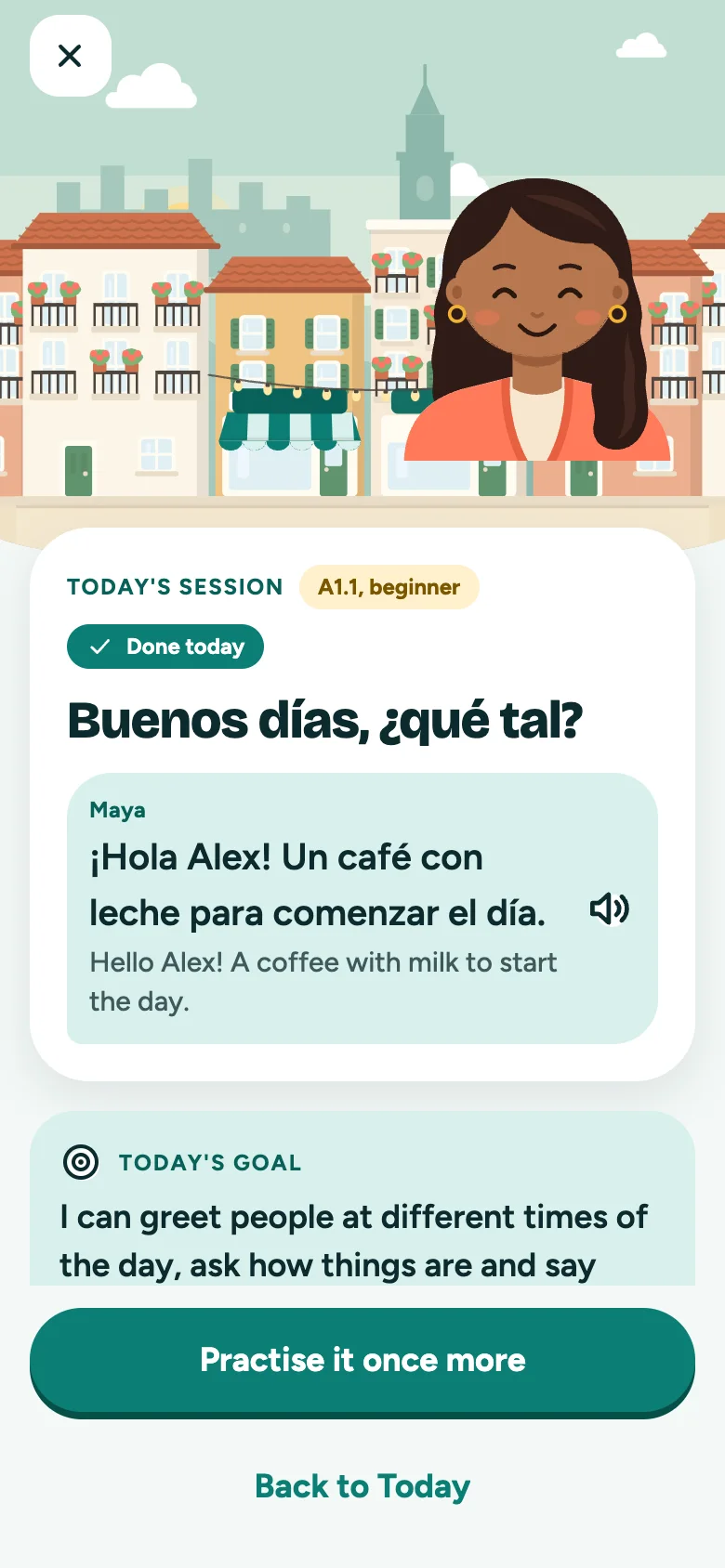
Every session has five short beats: catch up, listen, warm up, live it in a roleplay, and wrap up. The listening beat is a short scene set in a real place. The warm up is where you say the phrases out loud before the roleplay needs them. The roleplay is a conversation where you play yourself, and the wrap names what you did well, then fixes the one or two things worth fixing.
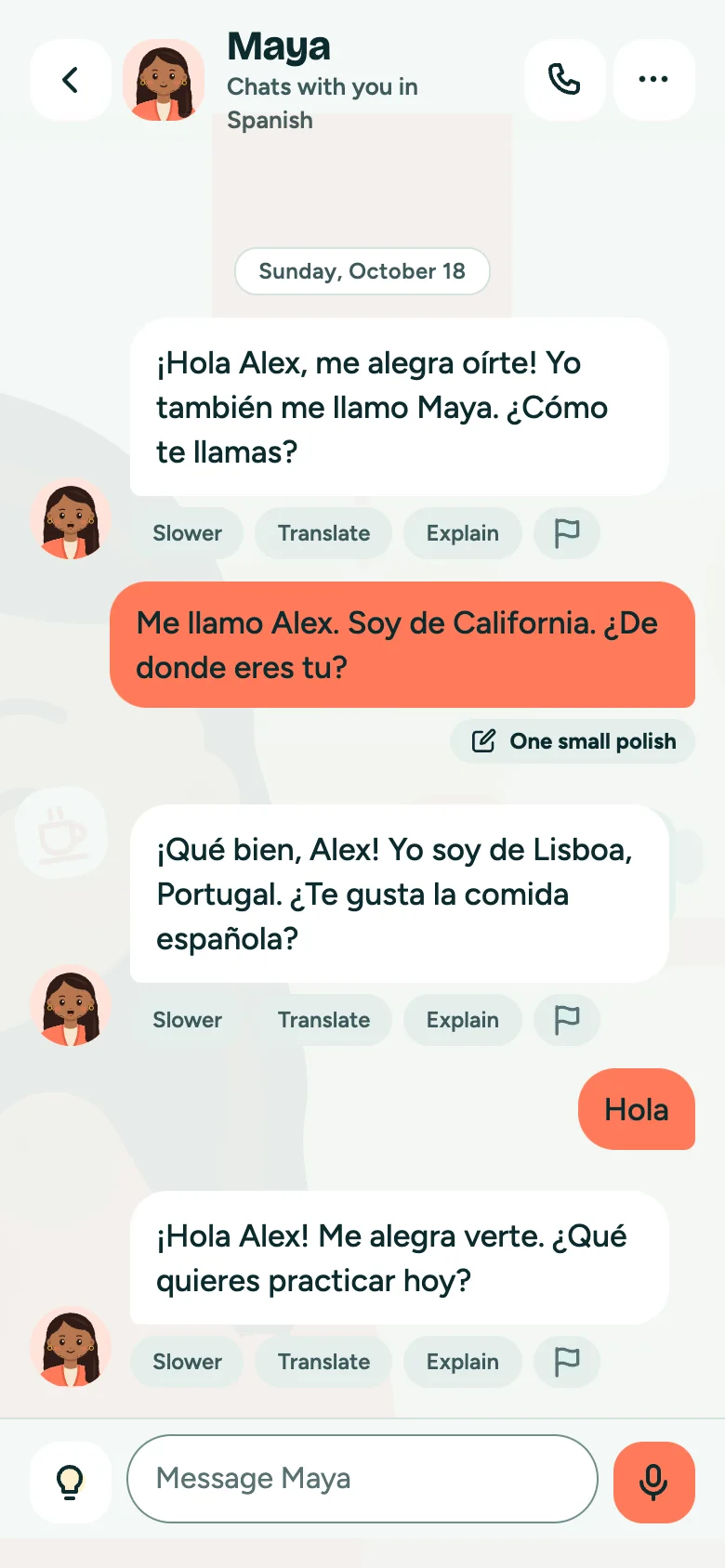
Your guide is a bestie, an AI friend with a character of their own. Nori, the sea otter, matches you with the one that suits you, and for Spanish the natural one to meet is Maya. Her mother, Carmen, is from Vigo in Galicia, and in the lessons Maya speaks the Spanish of Spain. She gives you the words first, waits for you to finish, and repeats your sentence back correctly inside her reply. Like every bestie, she is an AI friend, and she says so warmly when you ask.
A real sample lesson, step by step
This is the first session of the course, Hola, me llamo ... (Pre A1). In the lesson script the learner is called Mia.
- Catch up. Your bestie says in English: "Tell me what I should call you, and why you want to learn Spanish." Your answer shapes the sessions that follow. The first word is Hola, with a note that the h is silent: O-la.
- Listen. A scene at the welcome table of a community workshop. Lucía, a young volunteer, hands out name badges, and both of you use tú. You hear: Hola. Me llamo Mia. ¿Cómo te llamas? Each phrase is tagged with when you can say it and to whom.
- Warm up. You echo the phrases, then shadow the full lines with pointers like "the o is short and pure, with no ou glide, and in ¿Cómo te llamas? the voice falls at the end."
- Roleplay. You are a participant arriving at the table. You say hello, give your name, ask hers, and answer Encantada when she says she is pleased to meet you.
- Wrap. "You said hello, told someone your name, asked theirs and answered when they were pleased to meet you. That is a real first conversation in Spanish." The one correction on the list: Yo llamo Mia becomes Me llamo Mia, because me llamo is a fixed phrase.
It ends with a culture note: Spanish speakers carry two surnames, the father's first, then the mother's, and forms have two fields for them.
The roleplays that matter in real life
The course is built around situations you will really live. Three that learners ask about most:
- At a cafe. The Pre A1 session Un café, por favor: you ask for a drink politely and accept or decline an offer. Later sessions return to the same bar with pastries, with being a regular, and with making your order your own.
- A flat viewing. At A2, Visita al piso: you say what you like and what worries you while someone shows you a flat, with later sessions on leases and deposits.
- A doctor visit. At A2, Desde hace dos días: you say how long you have felt ill and what you do when it happens, with later sessions on booking, the consultation and phone appointments.
Travel, a new job, family and an exam each tune which sessions come first, so a nurse and a tourist do not get the same Week 3.
Talk after the lesson: chat, voice call and video call
In LingoBestie you can keep going after a session by chat, by voice call or by video call with your bestie, who remembers your week and asks how the thing you mentioned went. It is the answer to a plain need: a patient conversation partner at 11pm on a Tuesday.
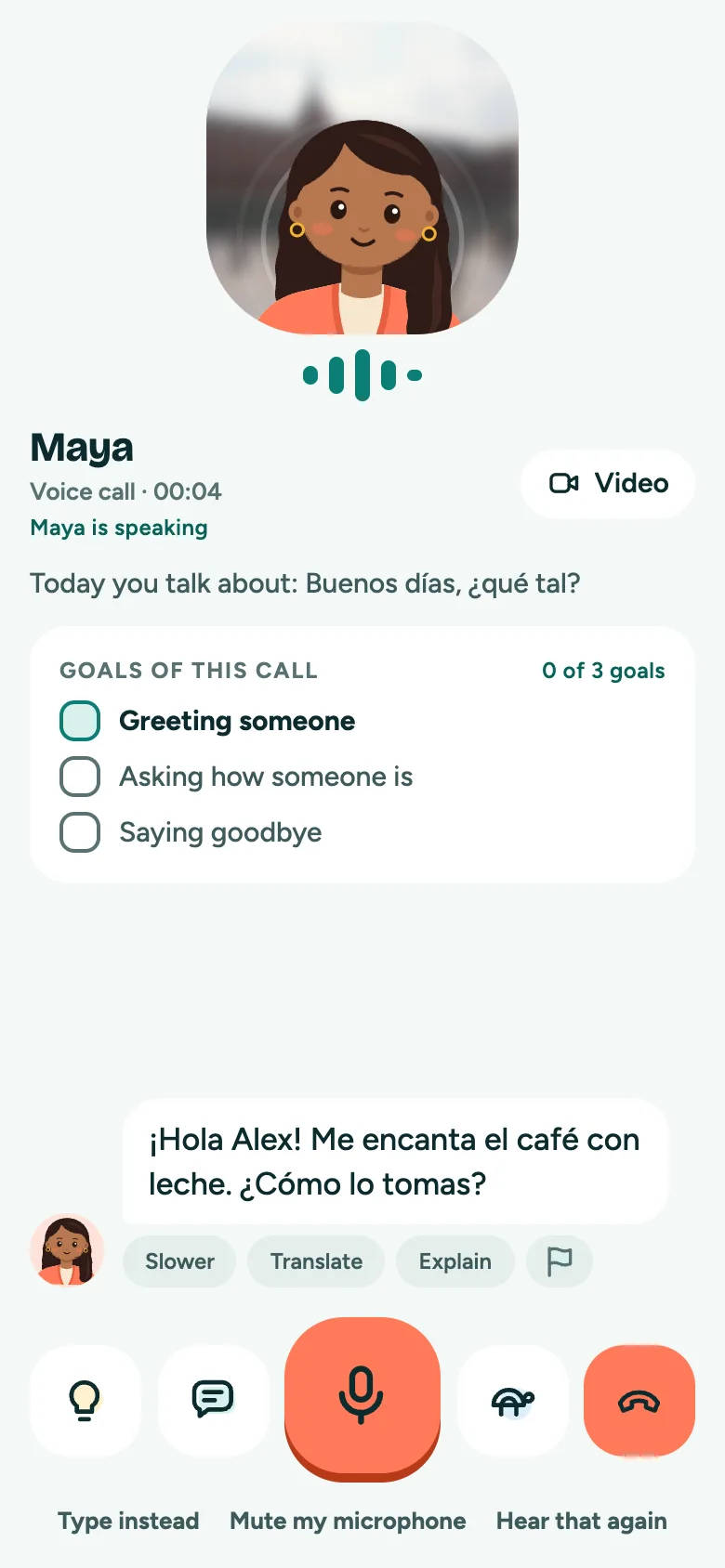
Plus opens the full course, every mode and every bestie, video calls, Watch and Listen, and exam practice. The yearly plan starts with 7 days free, and a reminder arrives before any charge. The app interface comes in 15 languages, iOS comes first, and there are six courses in all: English, Spanish, French, German, Japanese and Korean.
Best app to learn Spanish for beginners
For a complete beginner who wants to talk, LingoBestie is the strongest pick here: it starts at Pre A1 (before the first CEFR level), has a first session where you say hello and your name within minutes, and gives you a bestie to talk to from day one. If you want a free start, Language Transfer's first lessons are a gentle on ramp, and the two can run side by side. A beginner needs three things from an app: tiny steps, sound before spelling, and someone who answers.
Best app to learn Spanish for travel
For a trip you want situations, not grammar tables: ordering, asking the way, checking in, a doctor. LingoBestie has sessions on cafes, hotels and airports (check in, flight delays and lost luggage) and you can rehearse them by voice call before you leave. If your trip is in Latin America, pair it with the adaptation notes below. If you only want a pocket phrase list and audio, Pimsleur's Latin American course is the other strong choice.
Spain or Latin America: which Spanish will you learn?
Your LingoBestie lessons are in the Spanish of Spain, with the Latin American word or form named beside it in the notes. The voices are native and from Spain, and vosotros is taught. The course tells you which variety each line belongs to, so you always know what you are saying and where.
The numbers show how thorough that is. Across the 450 sessions, 448 carry a variant note, and 428 of those include a Mexico note, so you learn the Spain form and see the other one beside it. In the session where vosotros comes up, the note says that vosotros is the informal plural in Spain, that ustedes is the plural in Latin America and the formal plural in Spain, and, for example, that in Mexico "for several guests ustedes is the only plural, so Vienen, not Venís."
Why start from the Spanish of Spain? Two reasons that have nothing to do with which variety is better. The DELE comes from the Instituto Cervantes, a Spanish institution, so practising Spain forms keeps your exam practice and your lessons aligned. And a learner who knows the Spain forms can move to Latin American usage by removing: drop vosotros, swap a few words, and you are there. The course therefore gives you the wider range first, with the Latin American forms right beside it.
The vocabulary that changes
| English | Spain | Latin America (common) | Note |
|---|---|---|---|
| car | el coche | el carro (Mexico, Colombia), el auto (Argentina, Chile) | All three are understood widely |
| computer | el ordenador | la computadora (la compu) | |
| mobile phone | el móvil | el celular | |
| juice | el zumo | el jugo | |
| potato | la patata | la papa | |
| bus | el autobús | el camión (Mexico), la guagua (Cuba), el colectivo (Argentina) | The widest spread of any everyday word |
| flat | el piso | el departamento, el apartamento | |
| you all (informal) | vosotros ¿Cómo estáis? | ustedes ¿Cómo están? | Ustedes is formal plural in Spain |
| you all (formal) | ustedes | ustedes | |
| OK / fine | vale | ok, bueno, está bien, dale (Argentina) | Vale is everywhere in Spain, rare elsewhere |
| to take / to catch | coger | agarrar, tomar | Coger is rude in much of Latin America, especially in Argentina and Mexico; use tomar or agarrar there |
That last row is the one to remember, which is why the sessions explain it inside a situation, not in a footnote.
How to adapt in a week
If your plan is Latin America, use these three moves: (1) when the lesson says vosotros, learn to recognise it and answer with ustedes; (2) keep the vocabulary table above open for the first two weeks and swap the words as you meet them; (3) tell your bestie where you are going. Ask for the Latin American word and you get it, with the Spain one beside it.
The pronunciation difference is smaller than people fear. In central and northern Spain, c before e or i and z are a soft th (gracias sounds like "grathias"). In Latin America, the Canary Islands and much of Andalusia they are s. You will be understood either way, and you can choose to switch whenever you like.
DELE: which level to aim for and how the app practises it
The DELE has six levels, A1 to C2, and you choose the one you register for. The diploma is awarded by the Instituto Cervantes and is widely recognised as proof of Spanish level for study and work (DELE levels, Instituto Cervantes Leeds, checked October 2026).
Which level should you aim for?
- A2 is the first level that shows you can handle everyday exchanges. A learner finishing the A2 band of the LingoBestie course (session 285) is working at this level.
- B1 is the real target for most people: you can handle travel, work chat and family dinners, and the course ends here.
- B2 is the university and professional level. LingoBestie includes B2 exam practice so you can rehearse the formats once you move up from B1.
How the exam is built matters, because you practise each part differently. The B1 paper, taken as the example, has four parts of 25 points each and 185 minutes of exam time, plus 15 minutes of speaking preparation:
- Minutes
| Minutes | |
|---|---|
| Reading | 70.0 |
| Listening | 40.0 |
| Writing | 60.0 |
| Speaking | 15.0 |
Reading has five tasks, listening has five tasks, writing has two tasks (a written interaction and a written expression), and speaking has four tasks: a short presentation, a conversation, a photo description with follow up questions, and a simulated situation.
In the app, DELE practice follows the official formats. For each level from A1 to B2 there is a full mock exam plus practice sets by section: reading, listening, writing and speaking. Each answer gets feedback, so you learn why an option was wrong, not just that it was. Speaking is the part people fear most, and here you will have been talking to a bestie for weeks.
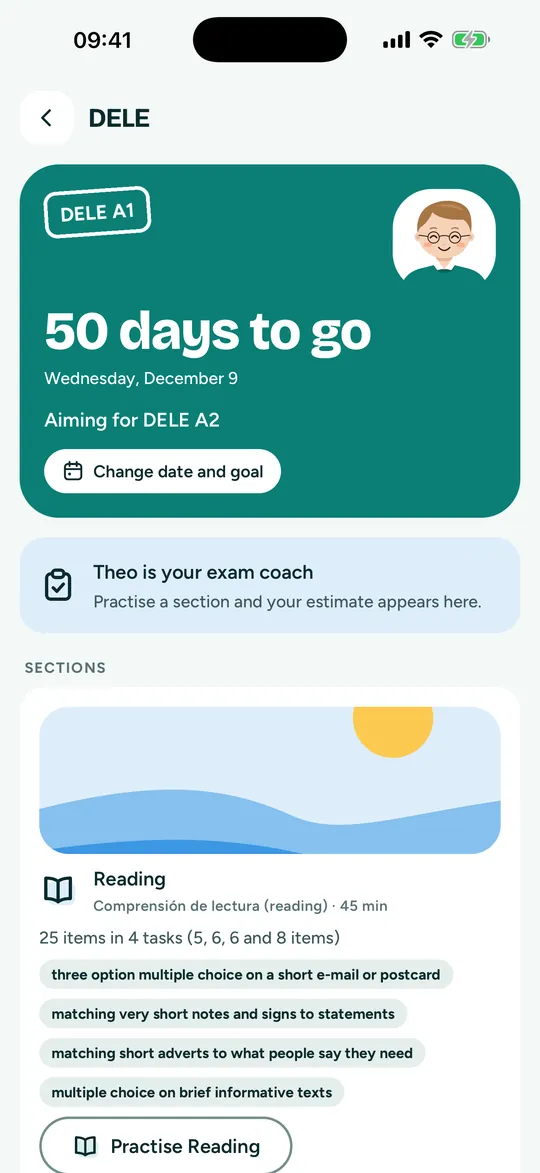
One plain limit: no app replaces sitting a real paper at a Cervantes centre. Use the app to learn the formats and build stamina, then register through the Instituto Cervantes when you are ready. If you want the full picture, read our DELE exam prep guide.
A 13 week Spanish plan from zero to your first conversation
Thirteen weeks is 91 days. At seven 15 minute sessions a week that is 91 sessions, enough for the 90 sessions of the Pre A1 and A1 bands, and it makes the first real conversation feel normal. The Pre A1 band (30 sessions) finishes in week 5. This plan is our design around the course structure, not a guarantee of fluency.
| Weeks | Course sessions per week | Chat and calls per week | Focus |
|---|---|---|---|
| 1 to 2 | 105 minutes (7 sessions) | 0 to 10 minutes | Sounds and survival |
| 3 to 4 | 105 minutes | 20 to 30 minutes | Text chat begins |
| 5 to 8 | 105 minutes | 30 to 50 minutes | First voice calls |
| 9 to 13 | 105 minutes | 50 to 70 minutes | Your own life in Spanish |
Weeks 1 and 2: sounds and survival. Seven sessions a week, so 14 sessions by the end of week 2. Say everything out loud, even alone. Five vowels, the rolled rr, and the greetings. By the end you can greet, give your name, order a coffee and say thank you.
Weeks 3 to 4: chat begins. Add 20 to 30 minutes a week of text chat. Write badly on purpose. Maya repeats your sentence correctly in her reply, and that is the technique.
Weeks 5 to 8: your first call. You finish the 30 Pre A1 sessions early in week 5 and move into A1. Start with voice calls of 10 minutes. The first one is the hardest, so book it for a day when you have just finished a session and the phrases are warm. Use the cafe and shop roleplays to prepare.
Weeks 9 to 13: your own life in Spanish. Tell your bestie about your week, your work, your family. By the end of week 13 you have completed A1 (session 90): you can introduce yourself, ask for things, talk about your day and understand slow replies.
Total over the 13 weeks: 22.75 hours of sessions (91 x 15 minutes) and about 9 hours of chat and calls (530 minutes), roughly 32 hours. That is under a third of the 112 hour course, and enough for a trip to Spain or Mexico where you order, ask and chat instead of pointing.
If speaking is where you stall, read our guide on how to practise speaking a new language. To see how the 600 to 750 hour FSI figure fits real life, read how long it takes to learn a language.
Common mistakes of English speakers, and the fix
Ser or estar. Both mean "to be". Ser is what something is (identity, origin, profession, time): Soy profesora. Es de Sevilla. Son las tres. Estar is where something is and how it is right now: Estoy en casa. Estoy cansada. The classic pair: Es aburrido (he is boring) against Está aburrido (he is bored). Fix: ask yourself "is this permanent identity or a state or location?" Roleplays at a flat viewing and at the doctor force both in one conversation.
Por or para. Para looks forward to a goal, destination or deadline: Es para ti. Salgo para Madrid. Es para el lunes. Por looks back to a cause, a route or an exchange: Gracias por tu ayuda. Paso por tu calle. Lo compré por diez euros. Fix: learn five sentences instead of the rules, and notice them in films.
Gender. El problema, la mano, el día, la foto. Nouns ending in -o are mostly masculine and in -a mostly feminine, but the exceptions are famous and you cannot reason your way out. Fix: always learn the article with the noun, and let the review sessions (89 of the 450) bring each one back.
Dropping the subject, or adding it. English needs I, you, he. Spanish usually does not: Tengo hambre, not Yo tengo hambre. Fix: leave it out unless you need to stress it.
Translating "I am cold". Spanish says Tengo frío (I have cold). The same goes for Tengo hambre, Tengo sed, Tengo sueño. Fix: treat them as fixed phrases, as the course does.
The false friends. Embarazada means pregnant, not embarrassed (Me da vergüenza). Actualmente means currently. Constipado means having a cold. Fix: note them once, out loud, and move on.
For a side by side with another well known app, see Duolingo vs LingoBestie.
Learning Spanish if your own language is French, German, Japanese or Korean
Most Spanish courses assume the learner speaks English. LingoBestie explains lessons in six languages, so a learner whose own language is French, German, Japanese or Korean gets the explanations in that language, with no English in the middle.
Each starting language has its own shortcuts and traps:
- French speakers have a head start: la maison / la casa, le livre / el libro. The trap is the false friends (librería is a bookshop, not a library) and Spanish pronunciation, which is more open and less nasal.
- German speakers already live with grammatical gender, but the genders do not always match: der Mond is masculine, la luna is feminine. Learn every noun with its article. Ich habe Hunger maps neatly to Tengo hambre, so use it as your model for the tener phrases.
- Japanese speakers already have five clean vowels, and Spanish vowels are the same five. The trap is gender and number agreement, which Japanese does not have, and a conjugated verb for every person.
- Korean speakers know a language where the verb comes last and politeness lives in verb endings. Spanish has a similar instinct in a different place: the choice between tú and usted. The course explains it as the Spanish version of the speech level you already know.
All four reach the same Spanish course, with the same bestie and the same roleplays, and explanations in the language they think in.
If your own language is Spanish and you want to learn English, see our Spanish language guides: las mejores apps para aprender inglés and practicar inglés hablando con IA. Learning another language with LingoBestie? See the guides for English, French, German, Japanese and Korean, or the wider best language learning apps comparison.
Our verdict
The most useful measure for learning to speak is how much you say out loud to something that answers. So pick the app where speaking is built into every session.
For beginners who want to talk, that is LingoBestie: structured from the first minute, a speaking partner on day one, and a clear path to a diploma if you want one. For free, start with Language Transfer. For a human, book Preply. For Latin America only, look at Babbel's Mexico course or Pimsleur.
Ready to try it? LingoBestie is on iPhone first. Download it, create your account, pick Spanish, and start the yearly plan with 7 days free, with a reminder before any charge. Your first session takes about 15 minutes.
FAQ
What is the best app to learn Spanish for beginners?
For a complete beginner who wants to talk, LingoBestie is our pick: 450 sessions starting at Pre A1, a roleplay in every session and a bestie you can chat or call. It is iPhone first. For a free audio start, Language Transfer works well, and the two can sit side by side.
Is Duolingo enough to learn Spanish?
It depends on your goal. Duolingo is a strong habit builder for vocabulary and basics, and says its most advanced courses reach the end of CEFR B2 (source: Duolingo Score, checked October 2026). It works well for daily routine, but most learners add speaking practice elsewhere, with a tutor, a language exchange or an app built around conversation such as LingoBestie.
Is Babbel better than Duolingo for Spanish?
It depends. Babbel offers separate Spanish (Spain) and Spanish (Mexico) courses and lists levels A1 to C1 on its Spanish page (Babbel, checked October 2026), so it suits learners who want a clear variety and a lesson structure. Duolingo is free to start and built around a daily habit. Try the free lessons on both, and choose the one you open every day.
Is there a good free app to learn Spanish?
Yes. Language Transfer's Complete Spanish is a free audio course funded by donations (page, checked October 2026). Duolingo is free with ads, and Busuu's first Spanish course (A1) is free (Busuu, checked October 2026). For free speaking practice, language exchange apps such as Tandem and HelloTalk pair you with real speakers.
Should I learn Spanish from Spain or Latin America?
Learn the one where you will spend time, and know that the difference is small. Spain uses vosotros, coche and ordenador; Latin America uses ustedes, carro or auto and computadora. LingoBestie lessons are in the Spanish of Spain, with the Latin American form named beside it in the notes, so you can adapt in a week.
Do I need to learn vosotros?
Only if you will spend time in Spain. In Latin America ustedes is the only plural "you". Even if you never say vosotros, you will hear it in Spanish films, adverts and any bar in Spain, so it is worth being able to recognise.
How long does it take to learn Spanish?
The US Foreign Service Institute lists Spanish at 24 to 30 weeks, or 600 to 750 class hours, for professional working proficiency with instructors (FSI, archived copy, checked October 2026). That is a standard for working proficiency, not for a first conversation.
Can I learn Spanish in 3 months?
You can reach a first real conversation. Thirteen weeks at about 15 minutes a day of sessions plus chat covers the Pre A1 and A1 bands of the LingoBestie course (90 sessions, roughly 32 hours with chat and calls). That is the level of ordering, asking and talking about your day, not fluency. The full course to B1 is about 112 hours of sessions.
Can an app prepare me for the DELE?
An app can teach you the formats and the timing, and give you practice on every part. LingoBestie includes DELE format mock exams and section practice from A1 to B2, with feedback on every answer. Busuu also lists an exam preparation track. The diploma itself is awarded only by sitting an official exam at an Instituto Cervantes centre.
What is the best app to learn Spanish fast?
Speed comes from speaking daily, not from a feature. A fifteen minute session plus a short chat or call each day beats two long sessions a week. The 13 week plan above is built on that.
What is the best app to learn Spanish for travel?
For a trip you want situations: ordering, asking directions, checking in, a doctor. LingoBestie sessions on cafes, hotels and airports (check in, delays, lost luggage) are built for it, and you can rehearse them by voice call before you leave. Pimsleur's audio courses are a good companion for the journey itself.
Does LingoBestie work on Android?
LingoBestie is iPhone first, so start on an iPhone. If you use Android today, Duolingo, Babbel, Busuu and Rocket Spanish are the choices above to start with.
Sources
All checked October 2026. Competitor facts also carry their link in the table above.
- Babbel, Spanish: https://www.babbel.com/learn-spanish (Spain and Mexico courses, levels A1 to C1 listed, Babbel Speak beta).
- Busuu, "Best Apps to Learn Spanish": https://www.busuu.com/en/spanish/best-apps-to-learn-spanish (A1 to B2 standard course, certificates "aren't accredited like a DELE or SIELE exam", Advanced Spanish Exam Preparation track, AI Conversations, pricing tiers). We did not use the Busuu help centre pages, which block automated fetch, so we state A1 to B2 only.
- Duolingo, Max help page: https://www.duolingo.com/help/what-is-duolingo-max (page returned no readable text to automated fetch); Duolingo blog, Video Call (Max subscribers learning English, Spanish, French, German, Italian and Portuguese): https://blog.duolingo.com/video-call ; Duolingo Score (B2): https://blog.duolingo.com/duolingo-score/
- Pimsleur, Spanish (Latin American): https://www.pimsleur.com/learn-spanish-latin-american/ (speakers from Colombia, Argentina and Mexico; "Buy 30 Lessons at a Time"; free lesson). Spain (Castilian): https://www.pimsleur.com/learn-spanish-spain-castilian/
- Rocket Languages, Rocket Spanish: https://www.rocketlanguages.com/spanish
- Preply, Online Spanish tutors: https://preply.com/en/online/spanish-tutors ("starts from $3, with an average of $17"; Spain $35 and Mexico $27 an hour; price filter in EUR)
- Language Transfer, Complete Spanish: https://www.languagetransfer.org/complete-spanish (Free Courses link, donation button; the page does not name a Spanish variety)
- Spanish as an official language: https://en.wikipedia.org/wiki/List_of_countries_and_territories_where_Spanish_is_an_official_language
- Instituto Cervantes, DELE B1 exam guide: https://examenes.cervantes.es/sites/default/files/guia_examen_dele_b1.pdf ; exam page https://examenes.cervantes.es/es/dele/examenes/b1 (now redirects to https://cervantes.org/es/examenes/dele). Speaking preparation time of 15 minutes is also noted in the LingoBestie DELE B1 spec.
- Instituto Cervantes, DELE levels and validity (Leeds centre): https://leeds.cervantes.es/en/dele_spanish/dele_diploma_levels.htm
- Council of Europe, CEFR level descriptions: https://www.coe.int/en/web/common-european-framework-reference-languages/level-descriptions
- US Department of State, Foreign Service Institute language difficulty (archived copy; the current state.gov page blocks automated fetch): https://webarchive.library.unt.edu/web/20210105072258/https://www.state.gov/foreign-language-training
- LingoBestie course data, reproduced by script:
content/seo/scripts/spanish-facts.pyreadscontent/courses/es/syllabus.json(450 sessions; bands 30, 60, 195 and 165; 271 core, 90 listening and 89 review sessions) andcontent/courses/es/packs/*.json(448 sessions with a variant note, 428 with a Mexico note). Prices come from the plan catalogue in the app (US list prices $79.99 a year, $14.99 a month, 7 day trial on the yearly plan). DELE practice sets are incontent/exams/dele. Checked October 2026.
Photo credit: cafe photo from Pexels (photo 20661977), used under the Pexels License. Illustrations of Maya and Nori are LingoBestie artwork.