On this page
- What "fluent" means (and why B1 is the useful target)
- The official hour estimates: what FSI and Cambridge actually say
- How long does it take to learn each language?
- Minutes per day against months to B1
- Why other pages give different numbers
- How to measure your own hours
- If you already speak a related language
- How our course maps to these numbers
- What speeds you up
- What slows you down, and the fix for each
- Questions we are asked most
- Go deeper by language
- Sources
By the LingoBestie editorial team. Last updated 1 November 2026. Every number below comes with its arithmetic, and the sources are listed at the end.
The short answer. To reach B1, the level where you can handle travel, small talk and everyday work conversations, an English speaker needs roughly 375 hours of real study for Spanish, 410 for French, 500 for German, and about 940 (Korean) and 1,010 (Japanese). Korean and Japanese are ranges, not single numbers: plan on about 800 to 1,200 hours for either. At 30 minutes a day that is about 25 months for Spanish and about five and a half years for Japanese. At 60 minutes a day it is about 12 months for Spanish and 33 months for Japanese. These are planning estimates built from published institutional figures, not promises. Checked October 2026.
Every language learner has met the two bad answers. One says "fluent in three months", sold by someone with a course to sell. The other says "it depends", which is true and useless. This page offers a third answer: a number you can plan a year around, with the arithmetic shown so you can disagree with it.
Here is the method in one paragraph. We take the two institutional hour counts that exist for English speakers and for the CEFR scale: the US Foreign Service Institute (FSI) category estimates and Cambridge English guided learning hours. We turn them into hours for six languages. Then we divide by the minutes you actually have. Every assumption sits in a table you can check, and the data is in a downloadable CSV. Where a figure is our own editorial judgment rather than a published number, we say so in the same sentence.
What "fluent" means (and why B1 is the useful target)
"Fluent" has no official definition, which is exactly why the internet's answers conflict. One person means ordering coffee, another means arguing about politics, another means passing as a native. The Council of Europe's CEFR scale is the closest thing to a shared ruler. Six levels, and the plain-words version of each:
| CEFR level | Name | What you can do, in plain words | Guided hours (cumulative) |
|---|---|---|---|
| Pre A1 | Starter | Recognise a few words and phrases, say hello, read the alphabet | under 90 (our editorial figure) |
| A1 | Beginner | Introduce yourself, order food, ask where things are, with slow and clear help | about 90 to 100 |
| A2 | Elementary | Handle shops, simple directions, your family and your day, in short sentences | 180 to 200 |
| B1 | Intermediate | Cope with most travel situations, tell a story, give opinions, follow clear speech on familiar topics | 350 to 400 |
| B2 | Upper intermediate | Hold a real conversation with a native speaker without strain, read articles, work in the language | 500 to 600 |
| C1 | Advanced | Speak fluently and flexibly, follow fast speech, use the language at university or in a profession | 700 to 800 |
| C2 | Mastery | Understand almost everything and express fine shades of meaning | roughly 1,000 to 1,200 |
Where the hours come from: A1 to C2 (except Pre A1) are from Cambridge English, Guided learning hours, checked October 2026. The A1 figure of 90 to 100 also appears in the Cambridge University Press paper "How long does it take to learn a foreign language?" (revised January 2018). The Pre A1 figure is ours. Cambridge describes all of these as approximate guidelines, counted cumulatively from zero, and they were written for learning English, so we apply them to other languages with the adjustment explained below.
Why B1 and not "fluent"? Three reasons. B1 is the first level at which the language starts to feel like yours rather than a test you are sitting: you can be left alone with a stranger, cope, and enjoy it. It is a concrete, testable milestone, so it is the one worth planning for. And it is a finish line that a daily 15 minute habit can reach, which is the level our own course aims at (more on that below). If you want B2 or C1, the table above already shows the ratios: B2 is about 1.5 times the B1 hours, and C1 about 2 times.
The official hour estimates: what FSI and Cambridge actually say
Two sources do the heavy lifting, and both get quoted loosely all over the internet. Here is what they say and what they do not.
FSI. The US State Department's Foreign Service Institute teaches diplomats and groups languages into categories by how long English speakers need in class. According to the State Department's Foreign Language Training page (archived copy captured 29 December 2024, checked October 2026; we cite the archive because it is a stable address):
| FSI category | Time to professional working proficiency | Examples relevant to this page |
|---|---|---|
| Category I | 24 to 30 weeks, 600 to 750 class hours | Spanish and French (both listed at 30 weeks, the top of the range) |
| Category II | about 36 weeks, 900 class hours | German |
| Category III | about 44 weeks, 1,100 class hours | The "hard languages", such as Russian, Hindi, Polish and Thai |
| Category IV | 88 weeks, 2,200 class hours | Japanese, Korean, Mandarin, Cantonese, Arabic |
Read the target carefully. FSI describes it as "General Professional Proficiency", a score of Speaking 3 and Reading 3 on the government (ILR) scale, roughly the level of a diplomat negotiating and reading a newspaper. Our reading, not an official mapping, is somewhere between B2 and C1. So "600 hours for Spanish" is not the time it takes to hold a conversation; you hold one far earlier. FSI also says its timelines are averages and that the real time varies with natural ability, prior experience and time in the classroom.
Cambridge. The table above counts "guided learning hours", which means time with a teacher plus guided self-study. It does not count the hours you spend watching a series on your own. That is both a strength (it measures structured effort) and a limit (it ignores the large benefit of living in the language).
The bridge between them. Cambridge gives the staircase for a language that suits the learner. FSI gives the ratio between languages. Our editorial method combines them in one step: take Cambridge's midpoint for B1 (375 hours) and scale it by how far each language sits from FSI's easiest category.
| Language | FSI category | Multiplier we apply to 375 hours | Hours to B1 (estimate) | Why this multiplier |
|---|---|---|---|---|
| Spanish | I | 1.0 | 375 | Regular spelling, huge shared vocabulary with English |
| English, for a speaker of a related language | not rated (FSI is for English speakers) | 1.0 | 375 | This is what Cambridge's table was built for. Raise it for distant first languages |
| French | I | 1.1 | 410 | FSI lists French and Spanish at the same 30 weeks. The 1.1 is our editorial allowance for the gap between spelling and sound, which costs listening time |
| German | II | 1.33 (900 divided by 675) | 500 | Directly from FSI's ratio of Category II to the middle of Category I (675 hours) |
| Korean | IV | 2.5 | 940 | Same factor as in our Korean guide. Editorial: FSI's ratio is 3.3 but B1 is a lower bar than S3 and R3, so we damp it |
| Japanese | IV | 2.7 | 1,010 | Korean's factor plus a bit for three scripts and thousands of characters |
A note on rounding and on the two bottom rows. Hours are rounded to the nearest 10 (except Spanish, which is Cambridge's midpoint as is): 375 times 2.5 is 937.5, shown as 940, and 375 times 2.7 is 1,012.5, shown as 1,010. The factors 2.5 and 2.7 are our editorial judgment, not FSI figures. FSI's own ratio would give about 1,220 hours, but FSI measures a much higher destination than B1 and its hours are class hours, so the full ratio overstates the path to a conversational level. Treat the Korean and Japanese numbers as a range of roughly 800 to 1,200 hours.
Hours to A1, A2, B1 and B2 by language
Most people searching for "conversational" mean A2 or B1, so here are all four levels, using the same method (Cambridge midpoints of 95, 190, 375 and 550 hours, multiplied by the factor above and rounded to the nearest 10):
| Language | A1 | A2 (basic conversation) | B1 | B2 |
|---|---|---|---|---|
| Spanish / English (related first language) | 95 | 190 | 375 | 550 |
| French | 100 | 210 | 410 | 610 |
| German | 130 | 250 | 500 | 730 |
| Korean | 240 | 480 | 940 | 1,380 |
| Japanese | 260 | 510 | 1,010 | 1,490 |
All of these are cumulative hours from zero. The same table is in the CSV, together with the months at each daily time.
- Hours to A2 (basic conversation)
- Hours to B1
| Hours to A2 (basic conversation) | Hours to B1 | |
|---|---|---|
| Spanish | 190.0 | 375.0 |
| French | 210.0 | 410.0 |
| German | 250.0 | 500.0 |
| Korean | 480.0 | 940.0 |
| Japanese | 510.0 | 1010.0 |
How long does it take to learn each language?
Each answer below stands alone, then adds the detail that decides your timeline.
How long does it take to learn Spanish?
Spanish takes about 375 hours to reach B1 for an English speaker, by our estimate: roughly 12 months at an hour a day, or 25 months at 30 minutes a day. Basic conversation (A2) arrives at about 190 hours, around six months at an hour a day. FSI places Spanish in its easiest category.
Spelling is close to phonetic, the vowels are five clean sounds, and English shares thousands of Latin cousins (información, importante, restaurante). The cost arrives later, in the subjunctive and in rapid Caribbean or Andalusian speech. A beginner can order in a bar on day one: Una caña y unas patatas bravas, por favor. Early progress feels so fast that many learners stop at A2, so decide your B1 date in week one. For a first 30 days, see our Spanish guide. If a certificate is the goal, the DELE exam prep guide shows where B1 and B2 sit.
How long does it take to learn French?
French takes about 410 hours to reach B1, roughly 14 months at an hour a day. Basic conversation (A2) takes about 210 hours. FSI gives French and Spanish the same 30 weeks, but French asks for extra listening practice because spelling and sound drift apart.
French shares a great deal of vocabulary with English, yet silent endings and linked words (liaison) mean that what you read is not what you hear. Listening practice is worth double here. See the French guide.
How long does it take to learn German?
German takes about 500 hours to reach B1, roughly 16 months at an hour a day. Basic conversation (A2) takes about 250 hours. FSI puts German one category above Spanish and French, and our estimate follows its ratio of 900 class hours to 675.
Case, gender and verb-final clauses look frightening and are rule-bound: Ich habe gestern einen Freund in Berlin getroffen teaches the position of the participle once and for all. The hours go into the articles (der, die, das and their case forms). The German guide has a routine for the cases.
How long does it take to learn Korean?
Korean takes about 940 hours to reach B1 by our estimate, roughly 31 months at an hour a day, within a range of about 800 to 1,200 hours. Basic conversation (A2) takes about 480 hours. Hangul is a compact phonetic alphabet, so the early weeks feel fast and the speech levels take the later time.
Then come particles, verb-last order and speech levels. 저는 커피를 마셔요 ("I drink coffee", polite) is a different sentence in form from 커피 마신다 (plain) or 커피 마십니다 (formal). Choosing the level is a daily decision, not a footnote. Full plan in the Korean guide.
How long does it take to learn Japanese?
Japanese takes about 1,010 hours to reach B1 by our estimate, roughly 33 months at an hour a day, within a range of about 800 to 1,200 hours. Basic conversation (A2) takes about 510 hours. FSI lists it in Category IV at 2,200 class hours for professional proficiency.
Three scripts (hiragana, katakana, kanji), no spaces between words, politeness shifting verb endings (食べる plain, 食べます polite) and a reading load of roughly 2,000 characters for everyday literacy. It is the language here where listening to B1 and reading to B1 are very different timelines. Speaking can come surprisingly early because the grammar is regular; reading is the long part, so plan two timelines. The Japanese guide splits the two, and the JLPT N5 and N4 study guide turns the first levels into a calendar.
How long does it take to learn English?
English takes about 375 hours to reach B1 for a speaker of a related European language with a shared alphabet, which is the case Cambridge's table was built for. That is roughly 12 months at an hour a day. Allow more for a first language with a different script or very different sounds.
The spelling-to-sound mismatch costs listening time for everyone. If your goal is a score, IELTS speaking practice shows what B1 and B2 sound like in the test, and the best app to learn English page covers the options.
Minutes per day against months to B1
This is the table most readers came for. The formula is the one printed under it, nothing hidden.
Months to B1 = hours to B1 divided by (minutes per day times 30.44 days, divided by 60). One minute a day for a month is 0.507 hours. A 30 minute habit adds up to 15.2 hours a month. Once a figure passes three years, the years are in brackets.
| Minutes a day | Spanish / English (375 h) | French (410 h) | German (500 h) | Korean (940 h) | Japanese (1,010 h) |
|---|---|---|---|---|---|
| 15 | 49.3 months (4.1 years) | 53.9 months (4.5 years) | 65.7 months (5.5 years) | 123.5 months (10.3 years) | 132.7 months (11.1 years) |
| 30 | 24.6 months | 26.9 months | 32.9 months | 61.8 months (5.1 years) | 66.4 months (5.5 years) |
| 45 | 16.4 months | 18.0 months | 21.9 months | 41.2 months (3.4 years) | 44.2 months (3.7 years) |
| 60 | 12.3 months | 13.5 months | 16.4 months | 30.9 months | 33.2 months |
| 90 | 8.2 months | 9.0 months | 11.0 months | 20.6 months | 22.1 months |
| 120 | 6.2 months | 6.7 months | 8.2 months | 15.4 months | 16.6 months |
Read this table with three notes. First, the 15 minute row shows what a lone 15 minute habit adds up to on its own: over four years for Spanish. The way to shorten it is to add speaking and listening around the habit, and every row to the right of 30 minutes shows how quickly the total falls. Second, the numbers assume every minute is real study. A distracted minute does not count, and a minute of an enjoyable conversation counts more than a minute of flashcards. Third, hours compound with speaking and listening in the real world; people who live where the language is spoken beat this table easily.
- Spanish
- French
- German
- Korean
- Japanese
| Spanish | French | German | Korean | Japanese | |
|---|---|---|---|---|---|
| 15 | 49.3 | 53.9 | 65.7 | 123.5 | 132.7 |
| 30 | 24.6 | 26.9 | 32.9 | 61.8 | 66.4 |
| 45 | 16.4 | 18.0 | 21.9 | 41.2 | 44.2 |
| 60 | 12.3 | 13.5 | 16.4 | 30.9 | 33.2 |
| 90 | 8.2 | 9.0 | 11.0 | 20.6 | 22.1 |
| 120 | 6.2 | 6.7 | 8.2 | 15.4 | 16.6 |
How many hours a day should you study? The honest answer is the largest amount you can repeat for a year. Cambridge University Press's 2018 paper notes that research on spaced repetition and active recall indicates infrequent review leads to an accelerating decline of ability, and it describes programmes of just 2 hours a week with long gaps as less effective than more intensive ones. Our editorial rule: aim for 30 to 60 minutes of focused work, split across at least two kinds of activity.
Why other pages give different numbers
If you have read other "how long" pages, the figures will look different, and that is normal. Here is where the common ones come from and what each one measures (all checked October 2026).
| Source | What it says | What it measures |
|---|---|---|
| Cambridge English helpdesk | B1 350 to 400 guided hours, B2 500 to 600 | Guided hours (teacher plus set self-study), cumulative, written for learning English. The widely copied A2 to C2 staircase |
| Cambridge University Press, 2018 paper | B1 cumulative 350 to 490 for motivated adults with good teaching; 530 to 680 for teenagers with low motivation; 780 to 980 for children in a harder context | The same scale, but showing how much the learner and the setting move the answer |
| US State Department, FSI | 600 to 750 class hours (Category I) up to 2,200 (Category IV) | Class hours for English-speaking diplomats to reach Speaking 3 and Reading 3, a level above B1 |
| Busuu blog | You can learn "the basics" in about 22 hours | A figure from Busuu's own learner data for the very first stage, not a CEFR level |
Four things explain nearly every gap. Cambridge counts guided hours for English, FSI counts class hours for a much higher target, a company page often quotes one headline number for the first stage, and many pages mix the three. Our table keeps them apart: Cambridge for the level, FSI for the ratio between languages, your own daily minutes for the calendar. The cost is that we show a range and an arithmetic trail, where a headline number would be shorter.
How to measure your own hours
Your personal hours matter more than any table. A simple way to find them:
- Count only focused minutes: a session, a conversation, active listening with the transcript, reading with lookups. Background audio does not count.
- Keep a running total for four weeks. A phone timer or one line in a notes app is enough.
- Divide the total by four to get your weekly hours, then divide the hours still needed (from the table above) by your weekly hours. That is your number of weeks to B1.
- Re-check after the first month. If your pace is higher than planned, your date moves closer; if it is lower, change the daily minutes, not the goal.
If you already speak a related language
The multipliers in this page are for an English speaker learning a first foreign language. A related language usually shortens the road. A Spanish speaker learning French or Italian already owns much of the grammar and a large share of the vocabulary, so the table is an upper bound for you: plan with it, then re-measure after a month. A learner of Japanese who knows Korean (or the other way round) starts with a large share of vocabulary of Chinese origin, although the grammar and writing still need the full effort. No published table gives an exact discount for these pairs, which is why we give you the method to measure it rather than a number.
How our course maps to these numbers
LingoBestie's courses are built around about 450 guided sessions per language, from Pre A1 to B1, each about 15 minutes (the per-language counts are 450 for Spanish and German, and 460 for English, French, Japanese and Korean, in the live course). The course ends at B1, the level this page plans for. The arithmetic:
- 450 sessions times 15 minutes is 6,750 minutes, which is about 112 hours of guided sessions.
- Our estimate of Spanish B1 is 375 hours. So the sessions are the backbone, roughly 30 percent of the total, and the rest, about 260 hours, comes from speaking and real media: chats and calls with your bestie, plus videos, podcasts, audiobooks and books in the library.
- With one session a day you finish the course in about 15 months of daily practice (450 days), and with 45 minutes a day in total (one session plus 30 minutes of talking and media) the table puts you at B1 Spanish in about 16 months.
This is a guide, not a promise. It tells you where the hours come from, and it shows why the app is built as it is: the 112 hours give you structure, and the besties and the library add the speaking and the real media that fill the other 260. You speak in your very first minute. Your bestie remembers your week, so the practice conversations are about your actual life, which helps a daily habit last, and you can see and change what it remembers. You can chat, make a voice call or a video call with your bestie in the language, and the library gives real videos, podcasts, audiobooks and books with words you can tap. The courses cover English, Spanish, French, German, Japanese and Korean, the explanations come in any of those six languages, and the app itself comes in 15 interface languages.
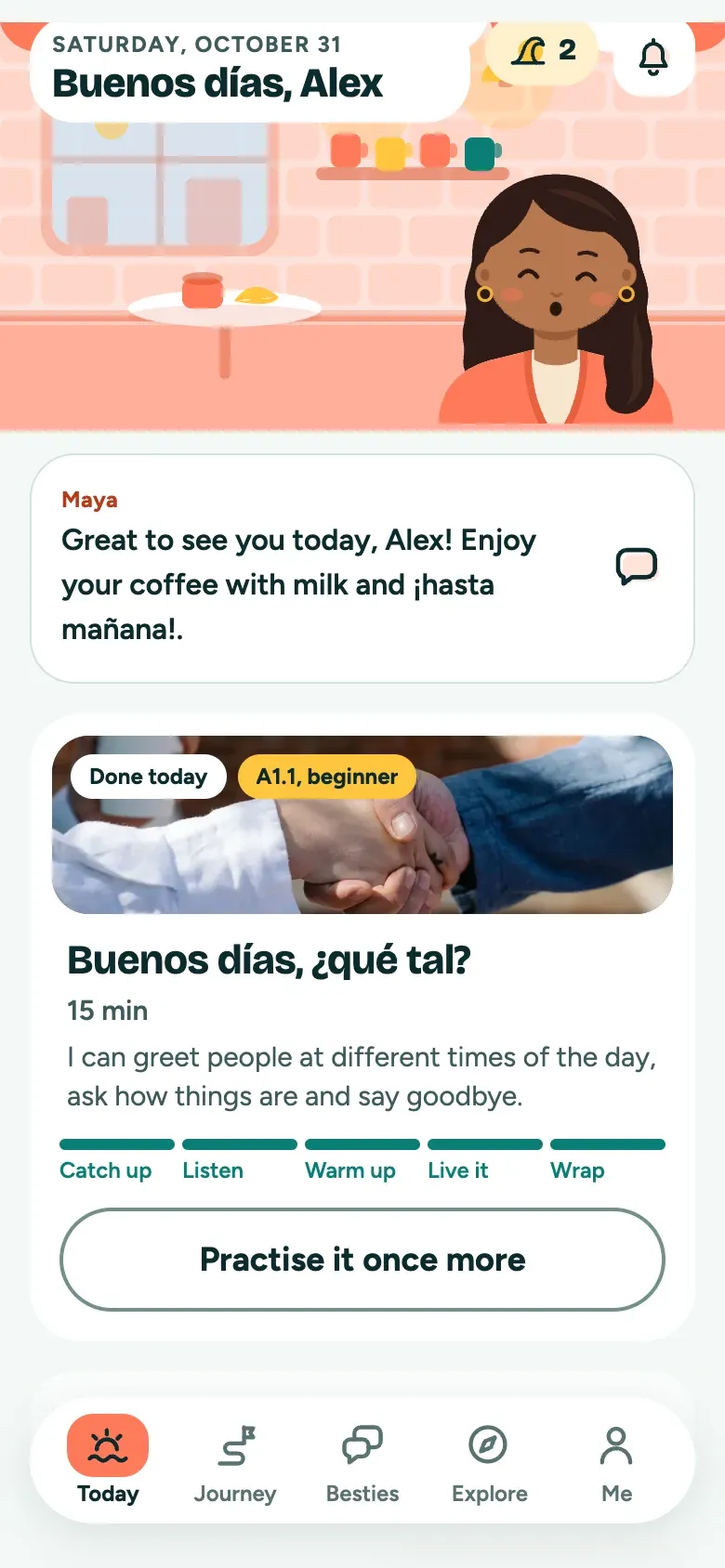
Two things in the design protect your hours. The first is the 15 minute session: small enough to survive a bad day, and every session has the same five beats (catch up, listen, warm up, live it in a roleplay, wrap up). The second is the rest day. The app gives you two rest days a week that keep your streak, so a busy week does not break the habit. Together they keep a 15 minute habit going through month three, which is where many timetables are won.
Ready to start your own count? Try LingoBestie on iOS: the yearly plan starts with 7 days free.
What speeds you up
These are the things that change the hours, in order of effect.
- Speaking from the first week. Output forces you to build the sentence yourself, and what you build you keep. Our guide on how to practice speaking a new language goes deeper. Even ten minutes of speaking a day makes your practice active instead of passive.
- Spaced review. Seeing a word again just before you forget it costs seconds and saves minutes. A simple pattern: the next day, three days later, a week later.
- Real media at your level. A short video in the language, with words you can tap to look up, gives the listening hours that classes rarely fit. Listening to understandable speech counts as exposure, and exposure is where B1 listening comes from.
- Memory of your own life. Words about your sister, your job and your Thursday interview stick far better than words about Anna and her cat. This is why our besties remember you and use it in the next session.
- Related languages. See the section above: a language close to one you know shortens the road. The multipliers in our table are for a first foreign language, so a second one will usually come faster.
What slows you down, and the fix for each
- Gaps. A two week pause costs more than the two weeks, because you reload before you move on. Fix: keep a two minute minimum on busy days.
- Passive study. Hours spent only reading lists of words count at a fraction of hours spent using them. Fix: turn every new word into a sentence you say out loud.
- Waiting to sound perfect. Waiting to speak until you are ready is a way of never starting. Fix: speak in week one, accent and all.
- Too little real speech. Learners who only use textbook audio hit a ceiling at A2 and cannot follow a fast waiter. Fix: add one real video or podcast a day.
- Switching languages every month. Each new language restarts your clock. Fix: finish one B1 first.
- A plan with no end date. "Learn Spanish" is a wish. "B1 by August, 45 minutes a day" is a plan, and the tables above give you the arithmetic for it.
Questions we are asked most
How long does it take to learn a language?
For an English speaker, reaching B1 takes roughly 375 hours in Spanish, 410 in French, 500 in German, and 940 to 1,010 in Korean and Japanese. At 45 minutes a day that is about 16, 18, 22, 41 and 44 months. The real time shifts with your first language and how much of your practice is speaking.
How long does it take to learn Spanish?
About 375 hours takes an English speaker to B1, which is 12 months at an hour a day. Basic conversation (A2) needs about 190 hours, or six months at the same pace. FSI's 600 to 750 class hours is the time to professional proficiency, a much higher level than either.
How long does it take to learn Japanese?
Our estimate is about 1,010 hours to B1, within a range of 800 to 1,200, so roughly 33 months at an hour a day. FSI lists Japanese in Category IV at 2,200 class hours for professional proficiency. Speaking arrives well before reading, so it helps to plan two timelines, one for each.
How long does it take to learn Korean?
About 940 hours to B1, roughly 31 months at an hour a day. Hangul is a compact phonetic alphabet, which makes the first month feel quick. The speech levels, which change verb endings by politeness, are where most of the later hours go.
How many hours a day should I study a language?
Aim for 30 to 60 focused minutes a day, mixing at least two activities such as listening and speaking. That is a pace most people can repeat for a year. If 15 minutes is all you have today, keep it going and add speaking or listening in the gaps of your day.
How many hours does it take to become fluent?
There is no official "fluent", so there is no official number. If you mean B2, a real conversation without strain, multiply the B1 hours by about 1.5. For C1 multiply by about 2. Cambridge lists 500 to 600 hours for B2 and 700 to 800 for C1, for a language that suits the learner.
How many hours to reach CEFR B1?
Cambridge English gives 350 to 400 guided learning hours for B1, for a language close to the learner's own. For distant languages multiply by a factor: our table uses 1.1 for French, 1.33 for German, and 2.5 to 2.7 for Korean and Japanese. Treat every figure as an approximation.
Can I learn a language in three months?
An hour a day for three months is about 90 hours, which is roughly the Cambridge figure for A1 in Spanish or French; for Korean and Japanese, A1 takes longer by our factors. B1 in 90 days means about four hours a day for Spanish (375 hours divided by 90 days is 4.2) and far more for Japanese, which is beyond what most schedules allow.
Can I learn a language in a year?
It depends on the language. An hour a day for a year is about 365 hours, which is close to the 375 hours of B1 Spanish. French and German take 14 to 16 months at that pace. Korean and Japanese reach A1 in about 8 to 9 months at an hour a day, A2 in about 16 to 17 months, and B1 in about 15 to 17 months at two hours a day.
Is it faster to learn a second language?
Often yes, especially when the new language is related to one you know, such as French after Spanish. You carry over vocabulary, grammar ideas and study habits. No published table gives a precise discount, so use our hours as an upper limit and measure your own pace after four weeks.
How long does it take to learn English?
For a speaker of a related European language, about 375 hours reaches B1, which is Cambridge's own guided-hours scale. That is 12 months at an hour a day. Speakers of languages with a different script or sound system should plan for more, and spelling-to-sound gaps slow listening for everyone.
Want a plan with a date on it? Try LingoBestie on iOS: the yearly plan starts with 7 days free.
Go deeper by language
- Planning Spanish: the first 30 days of Spanish and the apps that fit
- Planning French: apps and a listening routine for French
- Planning German: apps and a case routine for German
- Planning Japanese: apps for Japanese and how to split speaking from reading
- Planning Korean: Hangul and the speech levels
- Planning English: choosing an app to learn English
- Exams: the DELE for Spanish, JLPT N5 and N4 and IELTS speaking
- Methods: best language learning apps, compared and how to practice speaking a new language

Sources
Checked October 2026 unless a different date is given.
| # | Source | What we took from it |
|---|---|---|
| 1 | Cambridge English, Guided learning hours | A2 180 to 200, B1 350 to 400, B2 500 to 600, C1 700 to 800, C2 about 1,000 to 1,200. Approximate, cumulative, a guideline, written for English |
| 2 | Cambridge University Press, How long does it take to learn a foreign language? (revised January 2018) | A1 about 90 to 100 hours; cumulative hours for three learner contexts (B1: 350 to 490, 530 to 680, 780 to 980); the note on spaced repetition and infrequent review |
| 3 | US Department of State, Foreign Language Training (archived copy, 29 December 2024) | FSI categories: I 24 to 30 weeks (600 to 750 hours; Spanish and French at 30 weeks), II about 36 weeks (900; German), III about 44 weeks (1,100), IV 88 weeks (2,200; Japanese, Korean); target Speaking 3 and Reading 3 |
| 4 | Council of Europe, CEFR | The six level scale (Pre A1 is a common extension) |
| 5 | Busuu, How long does it take to learn a language? | The "basics in 22 hours" figure, from Busuu's learner data |
| 6 | LingoBestie | 450 to 460 sessions per language, about 15 minutes each, Pre A1 to B1; six courses; 15 interface languages; the yearly plan starts with 7 days free; two rest days a week. The product itself, October 2026 |
Our multipliers (1.0, 1.1, 1.33, 2.5, 2.7) are editorial judgments built on rows 1 and 3, not published figures. Data: how-long-hours-by-language.csv.